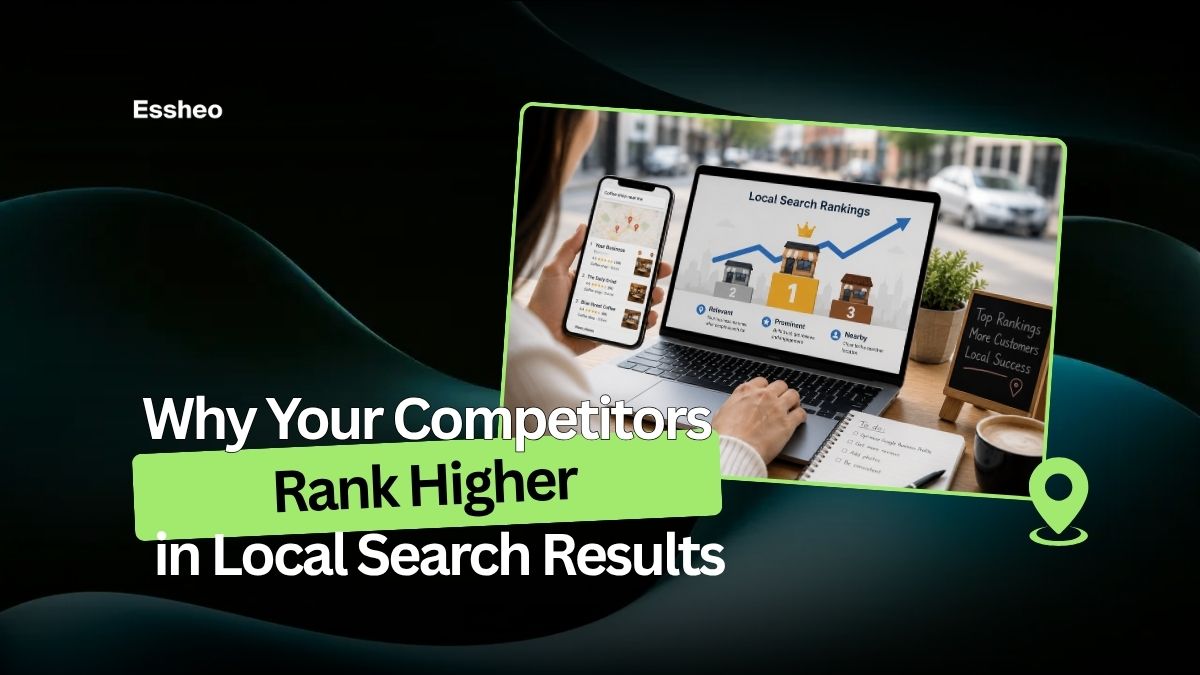
I get sent a lot of screenshots of Google search results, usually with the same message attached. “We do better work than this lot, why are they above us?” It’s a genuinely fair frustration, and it’s rarely about the quality of the actual installation work.
It’s almost always about a handful of specific, checkable gaps between your Google Business Profile and theirs, and once you know what to look for, most of these gaps take an hour to diagnose properly.
I’ve built and managed local search visibility for a boiler and solar installation business competing against national comparison giants, so I’ve run this exact diagnostic more times than I can count.
This post walks through the specific, observable reasons a competitor outranks you in the local pack, in the order you should actually check them, because some of these take an hour to fix and others take months.
What Actually Determines Who Wins The Local Pack?
Google has been consistent for years that local pack rankings rest on three factors: relevance, distance and prominence. Understanding which of these you can genuinely influence, and which sits largely outside your control, changes how you should prioritise fixing the gap.
Which Of These Factors Can You Actually Control?
Distance is the one factor you fundamentally cannot change, proximity to the searcher drives roughly 55% of local pack ranking decisions according to the Whitespark 2026 Local Search Ranking Factors Survey, making it the single heaviest individual factor in the entire algorithm.
If a competitor’s registered address genuinely sits closer to the searcher than yours, they will often win by default on certain searches regardless of how good your profile is. Relevance and prominence, by contrast, are entirely within your influence, and Google Business Profile signals specifically account for roughly 32% of total ranking weight, with review signals contributing a further 16% to 20%.
Is Your Google Business Profile Category The Problem?
This is the first thing I check on every single audit, because it’s the fastest to verify and, according to the same 2026 survey data, the single most important controllable factor in the entire local pack algorithm.
How Do You Check This Against A Specific Competitor?
Pull up the local pack result for your exact service and town, click through to your top three outranking competitors, and compare their primary Google Business Profile category directly against yours.
If your listing is set to something broad like “Contractor” while a competitor has selected “Heating Contractor” or “Solar Energy Company” specifically, that mismatch alone can explain a meaningful part of the gap, because weak category selection undermines relevance before proximity even comes into play.
Also check their secondary categories, since well-optimised competitors often layer several relevant secondary categories on top of a precise primary one, capturing a wider spread of related searches than a single category alone would.
Are You Losing On Review Volume, Velocity Or Recency?
Reviews are where I see the most confusion, because business owners assume it’s purely about star rating, when the reality is considerably more nuanced.
What Should You Actually Be Comparing?
Total review count matters less than most people assume. What genuinely moves rankings is review velocity, the rate of new reviews arriving consistently over time, review recency, since Google weights a review from last month considerably more heavily than one from two years ago, and response rate, with businesses replying to 80% or more of their reviews seeing measurable ranking improvements.
A competitor with fewer total reviews but a steady, recent stream, and genuine, specific replies to nearly all of them, will often outrank a business sitting on hundreds of older reviews that stopped coming in a while ago.
Check when your competitor’s most recent review arrived, and when theirs before that arrived, if there’s a consistent monthly cadence and yours has gone quiet for several months, that gap is very likely part of the story.
Is Your Profile Simply Less Complete Than Theirs?
Profile completeness is one of the fastest wins available, and it’s astonishing how often businesses leave genuinely easy signals sitting unfilled while wondering why a competitor with a more thorough listing outranks them.
What Specifically Should You Compare?
Open your competitor’s profile alongside yours and check the number of services listed with genuine descriptions rather than left empty, how many photos they’ve uploaded and how recently, whether they’re posting updates with any regularity, and which attributes they’ve filled in.
A profile with every service described, twenty or more genuine photos updated within the past month, and every relevant attribute completed sends a considerably stronger relevance and prominence signal than a bare-bones listing with the minimum required fields filled in.
Could Citation Inconsistency Be Working Against You?
This is a quieter, less obvious factor, but it genuinely erodes prominence over time if left unaddressed, and it’s one of the most common issues I find during an audit that the business owner had no idea existed.
How Do You Check For This Properly?
Search your business name across major directories, Yelp equivalents, trade association listings, local chamber of commerce sites, and check whether your name, address and phone number match exactly everywhere, including punctuation, abbreviations and suite numbers.
A business listed as “123 High Street” on one directory and “123 High St.” on another creates a small but genuine inconsistency that erodes the trust signal Google uses to verify your business is legitimately established at that address.
This typically takes half a day to properly audit and correct, but the prominence improvement tends to build gradually over four to eight weeks rather than appearing instantly.
Is Your Website Simply Weaker Than Theirs?
Once the profile-level factors are accounted for, website signals still play a meaningful role, particularly for on-page relevance and the trust signals that feed into prominence.
What Should You Check On The Website Itself?
Run your competitor’s site through a mobile page speed test and compare it against yours, since slow-loading pages genuinely suppress rankings, particularly given how much local search happens on mobile.
Check whether they have a dedicated, genuinely detailed page for the exact service and town you’re comparing, rather than a single generic page trying to cover everything, and check whether they’ve implemented LocalBusiness schema markup properly, since this feeds structured, unambiguous location data to both Google and increasingly AI platforms answering local questions directly.
A competitor with a faster site, dedicated service and location pages, and clean schema markup is working with a genuinely stronger foundation than one without these basics in place.
Does A Recent Algorithm Update Explain The Shift?
Sometimes the gap isn’t something you’re doing wrong, it’s a genuine shift in the local pack algorithm itself. Google’s local search updates occasionally reweight which signals matter most, and a business that hasn’t adjusted since the most recent change can find itself losing ground even without making any changes of their own.
How Do You Tell The Difference Between An Algorithm Shift And A Genuine Gap?
Check your Google Business Profile insights and any local rank tracking data for the timing of when your position actually changed, and compare that against known update dates. If the drop coincided with a documented core update, the fix likely involves adjusting to whatever that update prioritised, often profile completeness or review quality signals specifically.
If the change has been gradual over several months with no clear update correlation, it’s more likely that a specific competitor has simply improved their own signals steadily while yours stayed static, which points back towards the checklist above rather than an algorithm shift.
What Order Should You Actually Fix These In?
Not every gap deserves the same urgency, and tackling them in the wrong order wastes time on slow-moving fixes while quick wins sit untouched.
Which Fixes Should Come First?
Start with category selection and profile completeness, since these are roughly an hour of work each and produce the fastest, most direct impact given how heavily they’re weighted. Citation consistency comes next, typically half a day of audit work with prominence improvements building over four to eight weeks. Website content and schema markup follow, usually a week or so of proper work with ranking improvements unfolding over six to twelve weeks.
Review velocity and photo freshness need treating as an ongoing system rather than a one-off fix, since they compound gradually rather than producing an immediate jump. Backlinks and citations sit further out still, genuinely multi-quarter projects.
And proximity, along with how long your business has been established, are either partially or fully outside your control, so plan your strategy around them rather than expecting to fix them directly.
Why Does Getting This Diagnosis Right Matter More In This Sector?
Generic local SEO troubleshooting advice doesn’t fully account for the specific competitive pressure facing boiler, solar, heat pump, air conditioning and EV charger installers.
You’re not just competing against the installer two streets over, you’re checking your signals against national comparison giants like MoneySuperMarket, GoCompare and uSwitch in many searches too, which makes an accurate, properly prioritised diagnosis considerably more valuable than generic advice that doesn’t account for that scale of competition.
Every senior person on our team at Essheo has spent eight or more years running exactly this kind of diagnostic in genuinely hard to rank sectors, including direct experience competing for local visibility at a business that scaled past £65 million in turnover.
The strategies we’ve designed and implemented within our SEO service for service based businesses have contributed to over £45 million in combined client revenue across the last two years alone, built on precisely this kind of methodical, evidence-based approach to closing the gap with outranking competitors.
Ready To Find Out Exactly Why You’re Losing Ground?
If you’ve been wondering why a specific competitor consistently appears above you in local search, the answer is almost always sitting in one or two of the areas covered here, and it’s genuinely diagnosable rather than a mystery.
I set Essheo up to run exactly this kind of proper, evidence-based audit for boiler, solar, heat pump, air conditioning and EV charger installation businesses, identifying precisely which gaps are costing you rankings and prioritising the fixes that will move the needle fastest.
Book a strategy call with me today and let’s find out exactly why your competitors are outranking you, and fix it properly.