Category: AI SEO Guides

  • How to Measure Success From Generative Engine Optimisation

    How to Measure Success From Generative Engine Optimisation

    One of the most common questions I hear once a client has committed budget to GEO isn’t “is it working.” It’s “how would we actually know either way.” That’s a genuinely important question, because unlike traditional SEO, where a rank tracker and a Google Analytics dashboard tell most of the story, generative engine optimisation needs an entirely different measurement setup, and most marketing teams simply haven’t built one yet.

    I run Essheo, a search marketing agency working across the UK and US, and I want to use this post to set out exactly which metrics genuinely matter, which tools track them properly, and how to configure your existing GA4 property to catch the traffic your standard reports are currently missing entirely.

    Which Metrics Actually Matter for GEO Success?

    I’d start by being clear that GEO success isn’t measured on a single number. It requires a small set of complementary metrics, each answering a slightly different question about your visibility.

    What Is AI Visibility Rate and Why Does It Come First?

    AI Visibility Rate, sometimes called Visibility Score, is the percentage of tracked prompts where your brand appears anywhere in an AI-generated response, and it’s genuinely the top-line metric that answers the most basic question of all: are you visible in AI search at all.

    It should be tracked separately across each platform, ChatGPT, Perplexity, Google AI Overviews, Gemini, Claude and Copilot, as well as a weighted aggregate across all of them, because visibility on one platform doesn’t transfer automatically to another.

    I’d recommend building your prompt set from genuine buyer language rather than guessing, since a tracking set built around vague industry terms tells you very little about whether you’re actually visible for the questions your real customers ask.

    What Is Citation Frequency and How Does It Differ From a Mention?

    This distinction trips up a lot of marketing teams, so I think it’s worth explaining clearly. A mention is simply your brand being named in an AI response. A citation is specifically when an AI platform links back to a URL on your domain as the source for a claim. 

    Citation Frequency measures how often your specific URLs are cited as a source, calculated as the number of AI answers citing your URL divided by the total number of AI answers for your target query set, multiplied by one hundred.

    This matters because citations are the bridge between an AI answer and your actual website. A high mention rate with a low citation rate suggests AI systems know who you are but aren’t treating your own content as the authoritative source, which points toward a content and structure problem worth fixing directly.

    What Is Share of Voice and How Should It Be Calculated?

    Share of Voice measures your visibility relative to your competitors within the same answers, and there are genuinely two useful ways to calculate it. Mention-based share of voice looks at the percentage of AI response word count dedicated to discussing your brand across tracked prompts, so if a 150 word answer spends 60 words on you, that’s 40% share of voice for that specific query. 

    Citation-based share of voice instead looks at your citations as a percentage of total citations across all competitors for the same query set. I’d recommend tracking both, since a brand can score well on one and poorly on the other depending on whether AI platforms are naming you without linking to you, or linking to you without discussing you prominently.

    What Role Does Sentiment Play Alongside These Numbers?

    A genuinely important one, and it’s the metric most businesses skip entirely. Being cited or mentioned frequently doesn’t automatically mean you’re being described favourably. Sentiment tracking looks at whether the language surrounding your brand mentions is positive, neutral or negative, and whether qualifying or hedging language appears alongside your name. 

    A business with strong visibility numbers but consistently lukewarm or cautious sentiment has a different problem to solve than one that simply isn’t visible at all, and conflating the two leads to the wrong fix being applied.

    How Should You Build a GEO Reporting Dashboard?

    I’d recommend structuring this around a genuinely practical cadence rather than trying to review everything constantly, since over-monitoring tends to produce noise rather than useful signal.

    What Should Be Tracked Weekly Versus Monthly?

    Citation frequency and AI visibility rate for your priority queries are worth checking weekly, since these can shift meaningfully within short windows, particularly following model updates you have no control over. 

    Share of voice, sentiment analysis and a full competitive audit are better suited to a monthly cadence, since these benefit from a larger data sample to avoid reading too much into short-term noise. 

    I’d genuinely caution against relying on a single spot-check of a handful of prompts run once, since that tells you very little about your actual position. Meaningful tracking requires a consistent prompt set run repeatedly over time.

    Which Tools Actually Track These Metrics Properly?

    The landscape here has matured quickly through 2026. Otterly.AI tracks citations across six platforms starting from around £39 to £49 a month and has become a genuinely popular starting point for smaller teams. 

    Profound and Peec AI both offer confirmed multi-engine tracking across the four major AI assistants with strong competitive benchmarking features. Ahrefs has extended its Brand Radar feature specifically to track brand mentions across AI Overviews, ChatGPT and Perplexity, which is useful if your team already relies on Ahrefs for traditional SEO tracking.

    For agencies or larger in-house teams managing multiple brands or clients, Conductor offers a genuinely end-to-end enterprise AEO and GEO platform with content workflow integration built in.

    I’d recommend looking for five specific capabilities when evaluating any platform: prompt-level visibility tracking across multiple AI agents, citation-source analysis showing exactly which sources each agent cites in your category, competitive benchmarking against named rivals, content optimisation workflows rather than just reporting, and the ability to genuinely act on findings rather than simply observe them. 

    This is precisely the kind of layered tracking we build into client reporting at Essheo, because a tool that only reports numbers without pointing toward a fix leaves you no better placed to actually improve your position.

    Does One Tool or Strategy Work Across Every AI Platform?

    Genuinely, no, and this is worth understanding before you commit to a single measurement approach. 

    Analysis of citation behaviour across shopping-related queries found ChatGPT drawing 41% of its citations from earned media and 37% from retailer listings, while Gemini inverts that pattern, drawing 41% from retailer listings and 37% from earned media, and Amazon’s Alexa for Shopping leans overwhelmingly toward affiliate content at 73%. 

    There is no single AI SEO or GEO approach that performs identically across every agent, which is exactly why we build platform-specific measurement into every client strategy at Essheo rather than treating AI visibility as one undifferentiated channel.

    How Should You Configure GA4 to Actually Catch This Traffic?

    This is the part I think most marketing teams genuinely need walked through step by step, because AI referral traffic frequently gets misclassified or lost entirely in a default GA4 setup.

    Why Does Standard GA4 Miss So Much AI Referral Traffic?

    Because AI platforms don’t always pass referrer data the way traditional websites do, and GA4’s default channel grouping logic wasn’t built with AI assistants in mind. A meaningful share of AI-influenced traffic arrives looking like direct traffic in a standard report, simply because no referrer was passed at all. 

    Left unconfigured, this means genuine AI-driven visits get silently absorbed into your direct traffic bucket, making your GEO programme look like it’s doing nothing even when it’s working.

    What Custom Dimensions Should You Set Up First?

    Start in GA4 Admin, under Custom Definitions, and create event-scoped custom dimensions for page referrer, session source, and session source and medium together, since combining these catches classifications a single dimension alone would miss. 

    From there, build a custom segment specifically for AI-originated traffic, with conditions matching page referrer containing chat.openai.com, chatgpt.com, perplexity.ai, claude.ai, gemini.google.com, vertexaisearch, and copilot.microsoft.com.

    For a more robust setup, I’d recommend creating a dedicated AI Assistants channel group under GA4’s Channel Groups settings, adding a source condition using a regex matching your verified AI provider list, and positioning this channel above your standard referral rule so a matching session gets caught by the AI rule first rather than falling through to generic referral traffic. 

    This single step alone resolves a large share of the misclassification issue most GA4 properties currently have.

    How Should You Tag Content Specifically Aimed at AI Citation?

    For any link embedded within your schema markup, FAQ content, or comparison tables that an AI system might cite directly, apply consistent UTM parameters, using something straightforward like utm_source equals ai_assistant and utm_medium equals ai_assistant, so any resulting traffic remains clearly identifiable in your acquisition reports regardless of how the referrer itself gets classified. 

    Once your custom dimensions, channel group and UTM taxonomy are all in place, build an exploration report comparing AI referral traffic against organic search and standard referral traffic specifically on sessions, engaged sessions, average engagement time, and key conversion events, since AI-referred visitors frequently behave differently to standard organic traffic and that difference is itself a useful signal.

    This precise setup, custom dimensions, dedicated channel groups, consistent UTM tagging and a proper exploration report, is exactly the technical foundation we put in place for every client at Essheo before we ever report a single GEO result, because a strategy is only as credible as the measurement behind it.

    What Should You Do With This Data Once You Have It?

    Collecting these metrics only matters if they actually change what you do next, so I’d build a genuinely simple decision process around them.

    How Do You Know Whether to Adjust Your Strategy?

    If AI Visibility Rate is climbing but Citation Frequency stays flat, that typically points to a content structure problem, your brand is becoming known but your own pages aren’t being trusted as the source, which usually means revisiting how directly your content answers the specific queries you’re tracking. 

    If Share of Voice is strong but sentiment is consistently lukewarm, that points toward a trust and third-party authority problem rather than a visibility one, which needs a different fix entirely, focused on earned media and genuine reputation building rather than more content volume.

    How Often Should This Reporting Reach Stakeholders?

    I’d recommend a monthly summary reaching marketing leadership covering AI Visibility Rate trend, Share of Voice against named competitors, Citation Frequency movement, and any notable sentiment shifts, with the weekly citation and visibility checks feeding into that summary rather than being reported individually every time. 

    This is exactly the reporting cadence we run for every client at Essheo, whether you want us managing it hands-off with a monthly report landing in your inbox, or working hands-on alongside your own team reviewing the dashboard together.

    Ready to Build a Measurement Framework That Actually Proves This Is Working?

    If you’ve committed a budget to GEO without a proper measurement setup behind it, you’re not alone, and it’s a genuinely fixable gap. Most of the marketing teams I speak with are running GEO activity without the custom GA4 configuration or the dedicated tracking tools needed to actually prove it’s delivering, which means real results are quietly going unrecognised.

    At Essheo, every practitioner on our team carries 8 plus years of experience building measurable, defensible reporting in genuinely hard, competitive sectors, and we track visibility across Google, LLMs, YouTube and social platforms because a single dashboard measuring one channel was never going to tell the full story. 

    Our clients have generated over £45 million in combined revenue over the last two years through the systems we’ve designed and implemented, backed by proper measurement rather than guesswork.

    We’ll start with an honest audit of your current tracking setup, build the GA4 configuration and GEO monitoring framework your business actually needs, and set out a tailored reporting cadence that proves exactly what’s working. 

    Book a strategy call with me, and let’s make sure your GEO investment is something you can genuinely measure, not just hope is working.
  • What ROI Can Businesses Expect From GEO Services?

    What ROI Can Businesses Expect From GEO Services?

    I get asked to put a number on this constantly, and I understand why. Anyone signing off a marketing budget wants a defensible figure to justify the spend, not a vague promise about “future visibility.” 

    The honest answer is that GEO’s return on investment is genuinely measurable now, with real benchmark data behind it, but it requires a different measurement approach than the click-based reporting most marketing teams are used to.

    I run Essheo, a search marketing agency working across the UK and US, and I want to use this post to walk through exactly what the current data shows on GEO returns, how that return is actually calculated properly, and what timeline is realistic depending on your sector. I’d rather give you a genuinely useful framework than a single flattering number stripped of context.

    What Does the Current Data Show on GEO Returns?

    The most comprehensive cross-industry analysis I’ve seen tracked outcomes from 318 companies that had invested in AI visibility for at least six months, and found the median GEO return on investment across all industries sitting at 3.2 times within the first twelve months, meaning for every pound invested, companies reported £3.20 in attributable revenue impact. 

    That figure varies considerably by sector, which matters enormously for setting realistic expectations.

    E-commerce and retail brands saw the strongest results in that study, with a median 4.1 times return and payback in just 4.5 months, with 82% of tracked companies achieving positive ROI. 

    SaaS and technology companies weren’t far behind at 3.8 times return with a 5.2 month payback. A separate benchmark drawing on 84 client engagements and twelve third-party studies found even stronger figures in some B2B categories specifically, with median twelve month pipeline ROI reaching 11.4 times for B2B SaaS and 8.7 times for legal services. 

    I’d treat the higher end of that range cautiously, since pipeline ROI and realised revenue ROI are measuring different things, but the direction is consistent across every study I’ve reviewed.

    Which Industries See the Slowest Returns, and Why?

    Healthcare and manufacturing consistently show the longest payback periods, running 11 to 14 months in the cross-industry study, though they ultimately deliver strong total returns once that longer sales cycle plays out. 

    The same pattern held for consumer goods and professional services, both landing in the 8 to 9 month payback range with somewhat lower overall ROI multiples than ecommerce or SaaS. This tracks with what I’d expect intuitively. Categories with longer, more considered buying cycles simply take longer for AI-influenced discovery to convert into a closed sale, even if the underlying visibility work is progressing well.

    I think this is an important honesty check for any business building a case internally. If you’re in a sector with a naturally long sales cycle, a twelve month ROI benchmark borrowed from an ecommerce case study will set the wrong expectation entirely, and I’d always recommend anchoring your own projections to your sector’s actual buying behaviour rather than the most impressive figure you can find.

    What Do Realistic Investment Levels Look Like Against These Returns?

    Benchmark data breaking this down by sector and spend level found B2B SaaS companies typically investing £4,000 to £12,000 a month achieving 300 to 500% ROI within 4 to 6 months, ecommerce brands investing £2,500 to £8,000 a month achieving 150 to 300% ROI within 6 to 9 months, and local service businesses investing a more modest £800 to £2,400 a month achieving 200 to 400% ROI within a faster 3 to 5 month window. 

    That last figure is genuinely encouraging for smaller, locally focused businesses, since it suggests meaningful returns don’t require enterprise-scale budgets to achieve.

    Why Is Measuring GEO ROI Genuinely Different From Measuring SEO ROI?

    This is the part I think gets misunderstood most often, and getting it wrong leads directly to businesses either overestimating or badly underestimating their actual return.

    Why Doesn’t the Old Click-Based Model Work Here?

    Because GEO frequently doesn’t end in a click at all. Traditional SEO attribution followed a simple, linear path: query leads to click leads to session leads to conversion. GEO’s actual path looks different: a query generates an LLM answer, which produces a brand mention or citation, which results in an offline action, a phone call, a branded search days later, or a walk-in enquiry, often with no URL click involved anywhere in that chain. 

    Industry analysis puts this starkly: roughly 70% of AI-influenced traffic now arrives without any referrer data at all, meaning standard analytics simply can’t see where it came from.

    This creates what several analysts have started calling dark funnel or zero-click demand creation, genuine commercial influence that standard GA4 reporting was never built to capture. 

    Research into this attribution gap found that GA4, relying purely on direct referral tracking, typically captures only 10 to 20% of GEO’s true impact, with the remaining 80 to 90% showing up as branded search growth, direct traffic increases, and self-reported discovery that never gets tagged to its actual source.

    What Does a Proper GEO ROI Formula Actually Look Like?

    The most rigorous framework I’ve reviewed breaks this into three components. First, AI referral traffic value, meaning direct visits from ChatGPT, Perplexity and other AI platforms multiplied by your standard traffic-to-revenue conversion rate. Second, AI-influenced brand search lift, the measurable increase in branded search volume attributable to AI mentions, calculated as your branded search growth rate minus your established baseline growth rate from before GEO activity began. 

    Third, the AI mention conversion premium, the higher close rate typically seen on deals where a buyer was exposed to an AI recommendation naming your brand, which requires proper CRM tagging to capture accurately.

    Adding those three components together and subtracting your total GEO investment, covering content creation, technical optimisation and citation building work, gives you a genuinely defensible ROI figure rather than a vanity metric based on citation counts alone. 

    This is precisely the layered measurement approach we build into every client reporting structure at Essheo, because citation counts and visibility scores are useful upstream signals, but they were never the actual return itself.

    How Should a Business Practically Track This Without Expensive Tooling?

    I’d recommend five practical methods that don’t require a large martech budget to implement. Filter your GA4 referrers specifically for chat.openai.com, chatgpt.com, perplexity.ai, gemini.google.com and claude.ai to catch what direct AI referral traffic your analytics can see. 

    Add consistent UTM tagging to any link embedded in your schema markup or FAQ content that an AI system might cite directly. Track branded search impressions and clicks in Google Search Console month over month, since growth there without a corresponding paid branding campaign is a strong signal of AI-driven brand lift. 

    Add a simple “how did you find us” field to every lead form, including ChatGPT, Perplexity and Gemini as explicit options. And survey your most recently won customers directly during onboarding about whether an AI tool influenced their decision, since self-reported attribution genuinely fills gaps that no analytics platform currently catches reliably.

    What Timeline Should a Business Realistically Expect?

    I think this is where most businesses need the clearest, most honest expectation-setting, because impatience kills more GEO programmes than poor execution does.

    What Happens in the First Few Months?

    Consistently across every framework I’ve reviewed, the first one to three months function as a foundation phase, during which ROI often sits negative to modestly positive while technical infrastructure, structured content and citation-worthy assets get built out properly. 

    Initial AI visibility lifts typically become measurable within two to four weeks of implementing structured content and technical fixes, with citation rate beginning to climb for your priority queries. Statistically significant shifts in share of voice against competitors generally appear by weeks four to six.

    When Does Hard Financial Attribution Actually Start Appearing?

    Genuinely hard pipeline attribution, meaning inbound leads or demos that can be traced back to AI discovery, typically starts appearing in weeks six to ten, with self-reported AI discovery beginning to show up on intake forms and branded search trending upward around the same window. 

    Months four to six generally deliver 50 to 150% ROI as the optimisation phase takes hold, with months seven to twelve reaching 150 to 400% ROI as the programme scales into what most frameworks describe as a compounding growth phase.

    Does the Return Keep Improving Beyond the First Year?

    Substantially, based on every longer-term study I’ve reviewed. Year two and beyond frequently delivers returns in the 400 to 800% range and higher, as trust compounds exponentially once a brand becomes an established, repeatedly cited source within its category. 

    I think this compounding effect is the single most important thing for any stakeholder to understand before committing a budget. GEO isn’t a campaign with a fixed end date and a one-off return. It behaves much more like topical authority in traditional SEO, where the businesses that stay consistent for 12 to 18 months and beyond capture disproportionately larger returns than those expecting an immediate spike followed by a quick exit.

    This exact pattern is why we structure every client engagement at Essheo around 12 and 18 month growth strategies rather than short bursts of activity. The genuinely compounding returns the data shows only materialise for businesses willing to commit to that timeline properly.

    How Can Your Business Build a Credible ROI Projection?

    I’d never recommend simply lifting an industry benchmark and presenting it to your board as your own expected return, since the range across sectors and starting positions is simply too wide for that to be honest.

    What Inputs Do You Actually Need to Model This Properly?

    Start with your existing traffic-to-revenue conversion rate and average deal value, since these anchor every projection to your real business rather than an industry average. Establish your baseline branded search growth rate using at least six months of pre-GEO data from Search Console, so any lift you see afterward can genuinely be attributed to the programme rather than normal organic growth. 

    Then apply your sector’s realistic payback window from the benchmarks covered here, ecommerce and local services trending faster, healthcare and manufacturing trending slower, to set expectations that match how your specific customers actually buy.

    This grounded, business-specific modelling is exactly what we build into the strategy phase for every new client at Essheo, because a projection built from your own numbers is worth considerably more to a finance stakeholder than the most impressive case study from an unrelated sector.

    Ready to Build a Defensible ROI Case for Your Business?

    If you’ve read this far, you’ll understand why I’m reluctant to give you a single flattering number without the context behind it. GEO returns are genuinely strong across nearly every study I’ve reviewed, but the honest range spans from roughly 2.4 times to well over 11 times depending on your sector, your investment level, and how patiently your business is willing to let the compounding effect play out.

    At Essheo, every practitioner on our team carries 8 plus years of experience building measurable, defensible returns in genuinely hard, competitive sectors against household name rivals. 

    We rank businesses across Google, LLMs, YouTube and social platforms because no single channel captures the full picture any more, and our clients have generated over £45 million in combined revenue over the last two years through the systems we’ve designed and implemented, built on proper attribution, not vanity metrics.

    We’ll start with an honest audit of your current AI visibility and your realistic ROI potential based on your specific sector and starting position, then build a tailored roadmap with the measurement framework your finance team actually needs to see. 

    Book a strategy call with me, and let’s build a GEO business case with numbers you can genuinely stand behind.

  • How Much Traffic Can AI Search Generate for Your Business?

    How Much Traffic Can AI Search Generate for Your Business?

    I had a prospective client last month ask me, quite reasonably, to put a number on what AI search traffic could actually do for their business before they committed any budget. It’s the right question to ask, and I think it deserves a genuinely honest answer rather than an inflated one designed to close a deal. 

    So I want to walk you through exactly what the current data shows, including the parts of it that don’t necessarily flatter agencies like mine, because I’d rather you go into this with realistic expectations than disappointed ones.

    I run Essheo, a search marketing agency working across the UK and US, and this is a conversation I have often. The honest picture is more nuanced than either the hype or the scepticism you’ll find elsewhere online, and I think understanding that nuance properly is what actually helps a business plan sensibly.

    What Share of Traffic Does AI Search Actually Send Right Now?

    The honest starting point is that AI referral traffic remains a genuinely small slice of overall website visits for most businesses today, even as it grows quickly. Conductor’s 2026 AEO/GEO benchmark study, analysing traffic across ten major industries, found AI referral traffic sits at an average of 1.08% of total website visits, growing at roughly one percentage point month over month. 

    SE Ranking’s separate analysis of over 101,000 websites across 250 countries over sixteen months put the figure lower still, at 0.32% of all website traffic in 2026, up from just 0.02% in 2024, a sixteen-fold increase in two years.

    I’d be straightforward about why these figures vary. Different studies use different measurement methods, different site samples, and different definitions of what counts as an AI referral, which is exactly why I’d caution against fixating on any single headline percentage. 

    What matters more is the direction and speed of travel, and every credible study agrees on that: this channel is growing extremely quickly from a small base, even if the current absolute share is modest for most businesses.

    Which Platform Actually Sends the Most Traffic?

    ChatGPT dominates every dataset I’ve reviewed, though the exact share differs by study. Conductor found ChatGPT responsible for 87.4% of all AI referral traffic across its sample.

    SE Ranking’s larger dataset put ChatGPT at 74.78%, with Gemini second at 11.56%, Perplexity third at 7.23%, Copilot fourth at 3.51%, and Claude fifth at 2.62%. Separate research from AuthorityTech found ChatGPT sending 92.4% of standalone AI assistant referral traffic.

    Interestingly, one benchmark study analysing over 5,000 websites found a different pattern specifically among referrals that actually reach a website’s analytics, with Perplexity accounting for 54% of tracked AI search referral traffic, ahead of ChatGPT’s browsing mode at 28%. 

    The likely explanation is that Perplexity is built to actively cite and link to sources within its answers, while ChatGPT’s default mode, drawing on parametric knowledge, often answers without sending a click at all, even though it holds the largest overall usage base.

    Does Traffic Volume Vary Significantly by Industry?

    Considerably. Conductor’s research found IT and technology companies leading all sectors at 2.8% of total traffic from AI referrals, with consumer staples close behind at 1.9%, while communication services sat at just 0.25% and utilities at 0.35%. 

    That’s more than an eleven-fold difference between the strongest and weakest performing sectors, which tells you that generic, cross-industry averages can be genuinely misleading for planning purposes at an individual business level.

    I think this variation makes sense once you consider how people actually use AI platforms. Categories involving genuine research, comparison and technical decision-making, the kind common in technology, professional services and considered purchases, naturally generate more AI-assisted search behaviour than categories built around habitual, low-consideration purchases.

    Why Do the Top Performers See So Much More Traffic Than Average?

    This is genuinely the most important part of this data for any business building a business case, because the average figure hides a wide and telling spread.

    How Much Traffic Do the Best-Performing Businesses Actually Get?

    Substantially more than the headline averages suggest. Research analysing over 5,000 domains found the median AI search traffic share sitting at 3.2% of total organic and AI traffic combined, but top quartile performers reached 7.8%, and the top decile reached 14.3%. 

    Compare that with the bottom quartile, sitting at just 0.9%, and you can see the gap between businesses managing this properly and those leaving it to chance is roughly sixteen-fold.

    I think this single data point matters more than almost any other figure in this space, because it demonstrates that AI search traffic isn’t simply a function of luck, industry, or company size. 

    It’s substantially influenced by whether a business has actually built the technical foundations, content structure and third-party authority that earn citations, which is precisely the work we do with clients at Essheo.

    Is AI Referral Traffic Actually Growing Quickly Enough to Matter?

    Genuinely, yes, even from a modest current base. Conductor’s data shows AI referral sessions growing roughly 623% year on year as of April 2026. Separate industry analysis puts overall AI search engine influence on total web referral traffic at somewhere between 12% and 18% globally as of early 2026, up from just 5 to 8% in late 2024, with some forecasts suggesting this could reach 20 to 28% of total web referral traffic by the end of the year. 

    First Page Sage’s longitudinal panel of 218 client websites tracked AI platforms rising from just 0.11% of sessions in early 2023 to 6.24% of all sessions by July 2026, a genuinely dramatic multi-year climb even accounting for the different measurement approach.

    I’d encourage any business reading this to think in terms of trajectory rather than a single snapshot figure. A channel growing several hundred percent year on year, even from a small starting base, compounds into something genuinely significant within a relatively short window, particularly for businesses positioning themselves early rather than waiting until it’s a much larger, more contested space.

    Does Low Traffic Volume Mean AI Search Isn’t Worth Pursuing Yet?

    I don’t think so, and I want to explain honestly why the traffic percentage alone doesn’t tell the full story.

    Why Does Traffic Volume Understate the Real Value of AI Visibility?

    Because a meaningful share of AI search value never shows up as a click at all. Google’s own AI Overviews satisfy a large proportion of queries directly within the search results page, meaning your brand can be seen, and can influence a purchase decision, without ever generating a session your analytics can capture. 

    This is precisely why relying purely on referral traffic as your measurement of success in this space is genuinely misleading. It captures only the visible portion of a much larger influence effect happening upstream of the click.

    Separate research reinforces this. Seer Interactive’s study covering 2.43 billion impressions found brands cited within AI Overviews earn 120% more organic clicks per impression than uncited brands on the same query, even though overall click-through rates have fallen across the board. 

    And conversion data consistently shows the traffic that does arrive from AI platforms converts considerably better than standard organic traffic, often multiple times better, which means a smaller volume of AI-referred visitors can still generate a disproportionate share of actual revenue.

    What Should a Business Actually Measure Instead of Just Sessions?

    I’d track AI citation frequency across your core commercial queries on ChatGPT, Gemini, Perplexity and Google’s AI Overviews specifically, alongside branded search volume growth over time, since AI exposure frequently drives a delayed lift in direct and branded search rather than an immediate click. 

    Shopify’s own Q2 2026 data found AI-recommended shopping sessions up 197% year on year, a figure that captures commercial intent far more precisely than a generic AI referral traffic percentage ever could for an ecommerce business specifically.

    This layered measurement approach, tracking citations, branded search lift and conversion quality alongside raw traffic, is exactly what we build into client reporting at Essheo, because a narrow focus on session volume alone genuinely misses most of what this channel is actually delivering for a business.

    How Can a Business Realistically Estimate Its Own Potential?

    I’d never quote a generic traffic projection to a prospective client without first understanding their specific starting position, and I’d encourage any business to be equally sceptical of anyone who does.

    What Factors Actually Determine Your Realistic Ceiling?

    Your industry matters considerably, given the range from 0.25% to 2.8% average traffic share across sectors. Your current technical and content foundations matter just as much, given the sixteen-fold gap between top and bottom quartile performers on otherwise comparable measures. 

    And your competitive landscape matters too, since being one of the first genuinely well-optimised businesses in your category to pursue this typically captures disproportionate citation share compared with entering a category where several competitors are already doing this work properly.

    How Should You Set Expectations for the First Year?

    I’d encourage any business to treat the first two to three months as a baseline and foundation-building period rather than expecting immediate traffic volume, since technical fixes, structural content changes and third-party authority building all take time to be recognised and rewarded by AI systems. 

    From there, meaningful citation and traffic growth typically becomes visible within three to six months for businesses starting from a reasonably strong existing SEO position, extending toward six to twelve months for those building foundations from scratch. 

    This is exactly why we structure client engagements at Essheo around 12 and 18 month growth strategies, because the businesses reaching that top quartile performance genuinely earned it through sustained, properly executed work rather than a quick fix.

    Ready to Find Out What AI Search Could Realistically Do for You?

    If you’ve read this far, you’ll have noticed I haven’t given you an inflated number, because I don’t think that serves you well. AI referral traffic remains a modest share of total visits for most businesses today, but the gap between businesses in the top performance quartile and those doing nothing is roughly sixteen-fold, and the underlying growth trajectory is one of the fastest I’ve seen in search marketing in years.

    At Essheo, every practitioner on our team carries 8 plus years of experience building genuine, measurable search performance in hard, competitive sectors against household name rivals. 

    We rank businesses across Google, LLMs, YouTube and social platforms because no single channel tells the whole story any more, and our clients have generated over £45 million in combined revenue over the last two years through the systems we’ve designed and implemented, built on real operational results rather than inflated projections.

    We’ll start with an honest audit of your current AI visibility and a realistic assessment of your traffic potential based on your specific industry and competitive position, then build a tailored roadmap to move you toward that top quartile performance. 

    Book a strategy call with me, and let’s talk honestly about what AI search could genuinely deliver for your business.

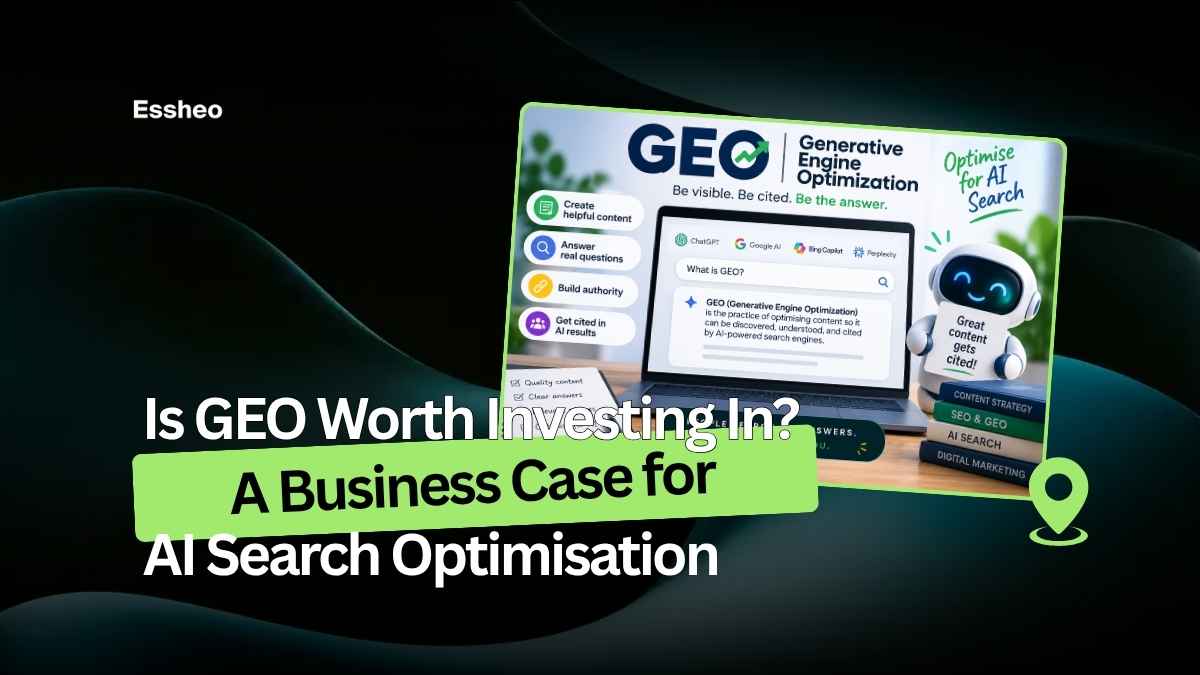
  • Is GEO Worth Investing In? A Business Case for AI Search Optimisation

    Is GEO Worth Investing In? A Business Case for AI Search Optimisation

    I get asked this question in almost exactly these words at least once a week now. A director or business owner wants to know, plainly, whether generative engine optimisation is genuinely worth the spend, or whether it’s a fashionable line item that agencies are pushing because it sounds current. 

    It’s a completely fair question to ask before committing budget, and I’d rather answer it honestly than simply tell you yes because I run a search marketing agency.

    I run Essheo, and before that I spent years building acquisition systems in genuinely tough, competitive sectors where every pound of marketing spend had to justify itself against hard numbers. So I want to build this business case the way I’d want it built if I were the one signing off the budget: with real costs, real returns, and an honest look at what happens if you decide to wait.

    What Does It Actually Cost to Invest in GEO Properly?

    Let’s start with the number most decision makers actually want first. Pricing guidance for 2026 shows most brands serious about AI search visibility spending between £4,000 and £9,500 a month on GEO retainers, with agency retainers more broadly ranging from £2,000 to £19,000 monthly depending on scope, and one-off launch projects typically running £4,000 to £15,000 upfront. 

    In-house specialist hires, where a business builds this capability internally rather than through an agency, typically cost £63,000 to £140,000 a year once salary and tooling are accounted for.

    I’d be straightforward with you: this isn’t a trivial spend, and any agency telling you otherwise isn’t being honest. But the comparison that actually matters isn’t whether GEO costs money. It’s whether it costs less, or delivers more, than the channels you’re already funding.

    How Does This Compare to What You’re Already Spending on Paid Search?

    This is where the numbers get genuinely interesting. WordStream’s 2026 benchmark data puts the average cost per lead from paid search at £55 to £58, with a blended cost per click of roughly £4.30 across industries. 

    A separate 2026 market study found B2B paid search cost per click up 29% year on year while click-through rate fell 26% over the same period, meaning businesses are paying considerably more for search advertising than they were twelve months ago while getting fewer qualified clicks for that spend.

    Organic and AI-driven search, by contrast, runs 60 to 68% cheaper per lead than paid search across most industries once a programme is established, according to benchmarking cited by NPR Design based on HubSpot and WordStream data. 

    That’s not a marginal difference. That’s the kind of gap that materially changes your blended customer acquisition cost over a full year of activity.

    Do GEO Leads Actually Convert as Well as Cheaper Paid Leads?

    Often considerably better, and this is the nuance I think gets missed in most cost per lead conversations. One widely discussed case documented a company nearly abandoning its GEO channel over a £51 premium in cost per lead compared with SEO, £44 per lead for SEO versus £51 for GEO, before realising the GEO leads converted 27% better. 

    The reasoning behind that gap is straightforward: when an AI platform names your business as the answer, the customer arrives largely pre-sold rather than still comparing ten open browser tabs.

    I think this is the single most important reframe for any stakeholder building a business case here. Cost per lead is genuinely a vanity metric when conversion rates aren’t equal between channels. What actually matters is cost per acquired customer, and on that measure, GEO frequently outperforms cheaper-looking paid alternatives once you follow the maths through to an actual sale.

    What Return Can a Business Realistically Expect?

    I think the honest, evidence-based answer is that returns vary by starting position, but the pattern across independent research is consistently positive.

    What Do Real Businesses Report Seeing?

    AI-referred traffic converts at roughly five times the rate of standard organic traffic according to aggregated 2026 research, and one enterprise programme documented earlier in 2026 saw a 6.8 times return over six months after restructuring existing content and adding dedicated AI-optimised assets. 

    Separate case study data covering sixteen months of ecommerce activity recorded a 2,087% average return on investment. I’ve referenced figures like these to clients before, and I always add the same caveat: these are strong results from businesses that executed properly, not a guaranteed outcome from spend alone.

    Yext’s most recent quarterly results, a company whose entire business is built around brand visibility across search and AI platforms, reported £82 million in revenue for the quarter with adjusted EBITDA of £25 million, a genuine commercial validation that enterprise demand for this category of work continues growing rather than plateauing.

    How Should a Business Actually Calculate Its Own Return?

    I’d recommend building this from your own numbers rather than borrowing someone else’s case study wholesale. Start with your current blended cost per lead and close rate, then estimate your realistic AI-citation share for your core commercial queries based on a proper audit, not a guess. 

    From there, model the incremental leads that citation share could plausibly generate at your existing close rate, and compare that projected pipeline value against the retainer or in-house cost of achieving it. This is exactly the kind of grounded, business-specific modelling we build into the strategy phase for every client at Essheo, because a generic industry statistic never replaces a number built from your actual sales data.

    What Does It Actually Cost to Do Nothing?

    I think this is the part of the business case most stakeholders skip entirely, and it’s arguably the more persuasive half of the argument.

    How Much Revenue Is Genuinely at Risk From Inaction?

    More than most businesses assume. Research modelling this specifically found that a mid-market company with £100 million in revenue and roughly 8.4% market share could have as much as £8.4 million in revenue exposed to a competitor’s AI visibility advantage, with the average mid-market company leaving an estimated £680,000 in AI-influenced revenue unprotected each year simply by not managing this channel. 

    That same research found brands with no AI visibility strategy lose an average of 18% of their digital influence annually to competitors actively managing their AI presence.

    In competitive categories specifically, brands absent from AI recommendations were estimated to lose around 8.4% of market share over 24 months to visible competitors. For a business with genuine competitors already investing in this space, that’s not a hypothetical risk. It’s a number with a real timeline attached to it.

    Does Waiting Actually Make the Problem Worse Over Time?

    Yes, and this is the detail I think should worry any business currently considering delaying this investment. The same research found the average cost to recover AI visibility after twelve months of neglect runs 3.2 times higher than the cost of maintaining it proactively from the start. Separate analysis modelling this compounding effect found that AI platforms genuinely reinforce brands they already cite. Early movers get mentioned more consistently over time, which trains future model updates to keep mentioning them, creating a widening gap that late entrants catch up to slowly rather than quickly.

    One detailed cost model for a firm with roughly £600,000 in exposed revenue found that if a modest competitor captured just 30% of that exposed flow, it would cost the business around £180,000 annually, and if that same business compensated by increasing paid spend to cover the gap, a £4,000 monthly cost increase adds a further £48,000 a year on top, with the cumulative gap against AI-visible competitors reaching £500,000 or more by year three. 

    I find this kind of modelling far more persuasive with sceptical finance stakeholders than any adoption statistic, because it puts an actual figure and a timeline against the cost of simply waiting.

    Is There a Reputational Risk Beyond Lost Revenue?

    Genuinely, yes. Research into this found brands not actively monitoring how AI describes them face an average 67 day window where AI errors can actively misinform potential buyers before anyone at the business even notices. 

    Separate research found brands cited accurately in AI answers saw a 22% higher trust score among surveyed buyers compared with brands AI systems couldn’t confidently describe. Left unmanaged, a single inaccurate AI summary can quietly shape buyer perception for months before a business even becomes aware it’s happening.

    Is GEO the Right Investment for Every Business?

    I don’t think it’s honest to answer this with an unqualified yes, so I won’t. The strength of the business case depends heavily on how your specific customers actually search and buy.

    When Does the Business Case Get Genuinely Strong?

    The strongest returns tend to sit with businesses in categories where customers compare options, ask for recommendations, or research extensively before committing, which describes most of the competitive service and product sectors I’ve worked in across my career. 

    If your customers are already asking ChatGPT, Gemini or Perplexity some version of “who’s the best provider for” your category, the cost of not being the answer to that question compounds daily, whether or not you’re tracking it.

    What Should a Business Do Before Committing Serious Budget?

    I’d never recommend committing a large retainer before establishing a proper baseline first. Run your core commercial queries through the major AI platforms, record honestly whether you or your competitors are being named, and use that evidence, not a generic industry statistic, to build your specific business case. 

    This is exactly how we start every engagement at Essheo, because a strategy built on your actual competitive gap is worth considerably more than one built on assumption.

    Ready to Build Your Own Evidence-Based Business Case?

    If you’ve read this far, you’ve probably already worked out that the real question isn’t whether GEO is worth investing in generically. It’s whether the specific gap between where your business currently sits in AI search and where your competitors sit is large enough, and growing fast enough, to justify closing it now rather than in twelve months’ time.

    At Essheo, every practitioner on our team carries 8 plus years of experience building acquisition systems in genuinely hard, competitive sectors against household name rivals and billion-pound comparison sites. 

    We rank businesses across Google, LLMs, YouTube and social platforms because relying on a single channel is no longer a sustainable strategy, and our clients have generated over £45 million in combined revenue over the last two years through the exact systems we design and implement. That track record comes from real operational experience, not theory.

    We’ll start with an honest audit of exactly where your business currently stands against your competitors in AI search, build the specific cost and return numbers your board actually needs to see, and set out a tailored roadmap with quick wins in the first few months and genuine compounding authority over 12 to 18 months. 

    Book a strategy call with me, and let’s find out whether the numbers stack up for your business specifically, not just in general.

  • How AI-Powered Search Engines Decide Which Brands to Recommend

    How AI-Powered Search Engines Decide Which Brands to Recommend

    A client asked me something recently that I think about a lot. She wanted to know why a smaller, less established competitor kept getting recommended by ChatGPT ahead of her business, despite her company being larger, older, and better resourced. 

    It’s a genuinely fair question, and the answer tells you almost everything you need to know about how AI recommendation actually works, because it has very little to do with company size and everything to do with trust signals most businesses have never deliberately built.

    I run Essheo, a search marketing agency working across the UK and US, and understanding exactly how AI platforms decide who to recommend is central to what we do for clients. I want to walk you through the actual mechanics here, because once you understand what these systems are genuinely evaluating, the path to earning a recommendation becomes considerably clearer.

    What Is Actually Happening When an AI Recommends a Brand?

    The first thing I always clarify with clients is that AI systems aren’t ranking brands the way Google ranks web pages. They’re doing something closer to reputation synthesis. Rather than matching keywords and counting backlinks, a large language model reconstructs a picture of your brand’s authority and trustworthiness fresh, on every single query, by drawing on two distinct sources of information.

    What Are the Two Clocks Every AI Model Runs On?

    I think of this as two clocks running at different speeds, and it’s a genuinely useful way to explain it to clients. The first clock is the model’s pretraining data, the enormous body of text it learned from before its knowledge cutoff, which shapes its baseline understanding of who you are and what your brand represents. 

    The second clock is real-time retrieval, the specific web pages the system pulls into context the moment it answers a live query. A brand’s authority in any given answer is the joint product of both clocks working together.

    This matters practically because it means you’re managing two separate things simultaneously. You can’t fix a negative baseline impression instantly through fresh content alone, because that impression is partly baked into the model’s training. But you can influence what gets retrieved live, which is exactly why ongoing content and authority building compounds over time rather than working as a single quick fix.

    Does the Model Form an Opinion the Way a Person Would?

    Not exactly, but the effect on the reader is remarkably similar. Research into this describes it as pattern synthesis rather than genuine opinion formation. The model weaves together patterns from product reviews, news coverage, social media discussion and technical documentation to form a contextual understanding of your brand, then generates new descriptions carrying implicit sentiment and authority based on those patterns. 

    If your brand consistently appears alongside language like “reliable,” “industry leading” or “well reviewed” across authoritative sources, the model learns and repeats that association. If it mostly appears in complaint threads or negative reviews, that becomes the baseline too.

    I think this is genuinely one of the more powerful, underappreciated aspects of AI recommendation. A positive mention inside an AI response carries an implicit third-party validation, because the AI appears to the user as a neutral, disinterested source simply sharing what it knows, not a business trying to sell anything.

    Which Trust Signals Actually Determine Whether You Get Recommended?

    Research across this space consistently converges on a similar structure, and I’ve found it genuinely useful to explain to clients as three connected categories of trust.

    What Are Website Trust Signals?

    These are the fundamentals sitting on your own domain: clear, unambiguous explanations of what your brand does, consistent positioning that doesn’t contradict itself between your homepage and your service pages, and structured data that makes your business legible to a machine rather than just persuasive to a human reader. 

    If an AI model can confidently explain your brand in a single sentence without hedging, that’s a strong signal your website trust signals are working.

    What Are Inbound Trust Signals and Why Do They Matter More Than People Expect?

    Inbound trust signals are everything outside your own website that guides potential customers, and models, toward you: media coverage, genuine customer reviews, industry directory listings, Wikipedia and Wikidata entries, analyst citations, and organic social proof of every kind. 

    Research into this consistently identifies third-party citation density, meaning how many independent, authoritative sources mention your brand in a relevant context, as one of the single most consistent predictors of whether a model recalls and recommends you.

    This is precisely why LLM training datasets favour authoritative, frequently cited sources. High-authority content is simply more likely to surface in outputs than content that only exists on a brand’s own site. I’d stress to any business reading this that a brand relying purely on its own website content, however well written, is addressing only one of three trust categories that actually determine AI recommendation.

    How Do SEO Trust Signals Fit Into This?

    Traditional SEO fundamentals still contribute meaningfully, not because rankings themselves are the goal any more, but because the same signals that earn strong organic rankings, technical crawlability, structured data, genuine topical depth, also make your content easier for an AI system to retrieve, parse and trust in the first place. 

    This is exactly why I never advise clients to abandon core SEO work in favour of GEO. The disciplines reinforce each other rather than competing for the same budget.

    How Do Sentiment and Mention Frequency Actually Shape Recommendations?

    This is the layer I think gets least attention from businesses, and it’s arguably the most important one to actively manage.

    Does It Matter How Often Your Brand Is Mentioned, or Just Where?

    Both, and research consistently ranks mention frequency as one of five core factors deciding which brands get recommended, alongside source authority, review sentiment, query fit and structured data. 

    Brands mentioned more frequently across the data a model has trained on and retrieved are simply more likely to surface when a relevant query comes in. But frequency without quality doesn’t compound the way businesses often assume. A brand mentioned constantly in low-authority, spammy contexts builds considerably less trust than one mentioned occasionally in a respected industry publication or a genuine comparison article.

    I’d also point out that authority in this context is topic-specific rather than domain-wide. A smaller brand that repeatedly and clearly owns a specific niche can outperform a much larger, more generalist competitor, provided its association with that niche is consistent and well documented across the web. 

    This is genuinely good news for smaller, specialist businesses competing against larger, better-resourced rivals, and it’s a dynamic I’ve seen play out directly in client accounts.

    Does the Sentiment Around Your Brand Genuinely Affect What the AI Says?

    Yes, and this is where I think most businesses have the biggest blind spot. AI sentiment analysis doesn’t simply count positive versus negative keywords. It evaluates comparative language, qualifying statements, where your brand sits within a recommendation hierarchy, and whether endorsing language is present or conspicuously absent.

    Sentiment can be drawn from two distinct places: web grounding, meaning the real-time sources an AI cites for a specific answer, and training data, meaning the general historical associations baked into the model itself.

    Practically, this means a cluster of negative Reddit threads or unresolved review complaints doesn’t just sit quietly on that platform. It can genuinely shape how confidently, or cautiously, an AI model describes your brand to a potential customer months or years later . I’d recommend any business genuinely monitor what’s being said about them across Reddit, review platforms and forums specifically, since AI training data carries that sentiment forward in a way traditional SEO monitoring was never built to catch.

    How Confident Is a Model in Recommending You If Signals Conflict?

    Considerably less confident, and the model’s hedging language will often show it. Research into B2B brand trust signals found that when independent signals align, meaning a brand appears consistently across reputable sources with stable positioning, clear expertise association, and evidence linked to specific outcomes, model confidence rises. 

    When those signals conflict, or when a brand’s positioning shifts noticeably between different sources, the resulting recommendation weakens, becomes vaguer, or gets dropped in favour of a competitor with a cleaner, more consistent footprint.

    Are Consumers Actually Trusting These AI Recommendations?

    I think this question matters as much as the mechanics themselves, because it determines how much genuinely rides on getting this right.

    How Widespread Is Consumer Trust in AI Product Recommendations?

    Considerable, and rising quickly, particularly in the UK. EY’s research found that 58% of UK consumers are now comfortable receiving AI-generated product suggestions, with 38% willing to add a recommended item directly to their basket based on that suggestion alone. 

    Consumers are increasingly using AI search specifically to compare products against their own budget and requirements, assess brand reputation, and evaluate alternatives before ever visiting a website directly.

    EY’s research also describes a genuine shift in how AI systems retrieve information, moving from deterministic keyword matching toward what it calls semantic retrieval, where content gets selected based on how probable it is to actually answer the query well, rather than how closely its keywords match. 

    This reinforces exactly the point I’ve been making throughout: it’s genuine trust, clarity and consistency that earn a recommendation now, not keyword density or paid placement alone.

    What Happens When AI Gets Your Brand Wrong?

    This is a genuine risk businesses need to take seriously. AI systems can misinterpret brand-owned content, user-generated commentary, or simply outdated information, leading to inaccurate or misleading representations of your brand that you may never even see unless you’re actively monitoring for them. 

    As AI increasingly shapes consumer perception at scale through these recommendations and comparisons, maintaining some control over your brand narrative becomes a genuinely commercial concern, not just a reputational one.

    This is exactly why proactive monitoring of how AI platforms describe your brand needs to become a standing part of any serious marketing operation, rather than an occasional check. It’s precisely the kind of ongoing tracking we build into every client engagement at Essheo, because a recommendation you’re earning today can quietly shift if negative sentiment accumulates somewhere you’re not watching.

    How Should Your Business Actually Build These Trust Signals?

    Bringing all of this together, I’d focus deliberately on strengthening each of the three trust categories rather than treating any single tactic as a complete fix.

    On your own site, make sure your positioning is genuinely consistent and unambiguous, and that structured data clearly communicates who you help, what problem you solve, and how you’re different, exactly the kind of clarity a model needs to confidently summarise you in one sentence. 

    Beyond your site, invest deliberately in earning coverage, reviews and mentions across genuinely authoritative, independent sources, since this inbound trust category is consistently the strongest predictor of recommendation across the research I’ve reviewed.

    And monitor sentiment actively across review platforms, forums and social discussion, because that sentiment feeds directly into how confidently AI systems describe you, whether you’re watching or not.

    This is precisely the search everywhere approach we take with every client at Essheo. We don’t treat your website, your third-party coverage and your platform presence as separate projects. We build them as one connected trust signal, because that’s genuinely how these AI systems evaluate you.

    Ready to Find Out What AI Is Actually Saying About Your Brand?

    If a competitor keeps appearing in AI recommendations ahead of your business despite being smaller or less established, it’s very rarely bad luck. It’s almost always a gap in one of the trust signals covered here, and those gaps are entirely fixable once you know where they sit.

    At Essheo, every practitioner on our team carries 8 plus years of experience building genuine authority and trust in hard, competitive sectors against household name rivals, and we work across Google, LLMs, YouTube and social platforms because recommendation trust today gets built across all of them at once, not on a single channel. 

    Our clients have generated over £45 million in combined revenue over the last two years through the systems we’ve designed and implemented, built on real operational results rather than theory.

    We’ll start with an honest audit of exactly how AI platforms currently describe your brand against your competitors, then build a tailored roadmap to close the trust gaps that matter most. 

    Book a strategy call with me, and let’s find out exactly what ChatGPT, Gemini and Perplexity are telling your customers about you right now.

  • Google’s AI Overviews: What They Mean for Your Business

    Google’s AI Overviews: What They Mean for Your Business

    I had a client last year who genuinely believed their SEO had stopped working. Rankings were fine, positions hadn’t moved, and yet enquiries had dropped noticeably. What had actually happened was that Google had started showing an AI Overview above their result for their most valuable search terms, and a competitor, not them, was the business being named and described inside it. 

    Their ranking hadn’t broken. Their visibility inside the answer had simply gone to someone else.

    I run Essheo, a search marketing agency working across the UK and US, and this scenario has become one of the most common things I help clients understand and fix. AI Overviews aren’t a future concern any more. 

    They’re already reshaping which businesses get seen and chosen across huge swathes of Google search, and I want to walk you through exactly how they work, what the data actually shows, and what your business needs to do about it.

    What Exactly Are Google’s AI Overviews and How Big Is Their Reach?

    AI Overviews are the AI-generated summaries Google displays at the top of search results, synthesising an answer from multiple web sources rather than simply listing links for a user to click through themselves. They launched broadly in 2024 and have expanded aggressively since, now running on Gemini 3 as their default underlying model globally. 

    As of early 2026, they were appearing on roughly 48% of all Google searches according to research into local search impact, with other analysis putting business-intent search coverage as high as 86.7%.

    The reach is now genuinely enormous. Google’s own reporting puts AI Overviews at around 2 billion monthly users across more than 200 countries, a figure that grew further once Google began rolling generative UI features, including custom calculators and interactive tools, out of AI Mode and into AI Overviews from 19 August 2026, expanding potential reach to approximately 2.5 billion monthly users. 

    For any business relying on Google as a primary discovery channel, that means close to half of relevant searches, and a growing majority of commercial ones, now show an AI-generated answer before a single traditional result.

    Do AI Overviews Actually Reduce Clicks to Websites?

    Yes, measurably. Google’s AI Overviews cut organic click-through rates by up to 46% according to research cited in local search studies, and separate longitudinal analysis found organic click-through rate falling from 1.62% to 0.61% on queries where an AI Overview appears, a 61% relative decline. 

    The important nuance, though, is that this happens because AI Overviews genuinely satisfy a portion of searcher intent on the page itself, not because your ranking has weakened. Impressions can stay flat or even rise while actual clicks fall, since your appearance inside an AI Overview still counts toward impression data even when the user never visits your site.

    There’s a meaningful upside buried in this though. Businesses cited as a source inside an AI Overview see click-through rates roughly 35% higher than businesses that appear nearby but aren’t cited. Being named inside the answer, rather than merely ranking somewhere on the page beneath it, is clearly still worth considerably more traffic than being overlooked entirely.

    How Does Google Actually Choose Which Sources to Cite?

    This is the part I think most business owners genuinely need explained properly, because the mechanics are more knowable, and more actionable, than most assume.

    What Happens Behind the Scenes When an AI Overview Is Generated?

    Google’s AI Overviews retrieve sources through a two-stage process. First, your query gets broken into anywhere from eight to sixteen sub-queries through a process called query fan-out, run in parallel to gather a wide pool of candidate content. 

    Second, those candidate passages are scored against relevance, source authority, freshness and structural clarity, with typically three to eight sources selected for the final synthesised answer.

    Crucially, Google’s system extracts answers at the passage level, not the page level. A page can rank on page fifteen of your site and still win a citation, provided the specific passage on it directly and clearly answers the exact sub-query Google generated. This is precisely why a shorter, sharply focused passage answering one specific question often outperforms a long, comprehensive page that never states its core answer plainly.

    Which Factors Actually Predict Whether You Get Cited?

    Research reverse-engineering more than 200 AI Overview citations identified seven structural factors, and the strongest by far is passage clarity, with a correlation of 0.84 to citation likelihood. 

    A passage directly answering a query in 40 to 80 words consistently beats a 3,000 word article that buries its answer somewhere in the middle. Original data, statistics or frameworks were the second strongest predictor at 0.71 correlation, and were present in 73% of cited passages across that same sample.

    Entity grounding, meaning whether your brand has a clear Wikidata entry, complete Organization schema with sameAs links, and consistent name, address and phone details across the web, correlated at 0.66, with businesses carrying strong entity signals appearing in AI Overviews at 3.2 times the rate of otherwise similar content without them. 

    Author E-E-A-T signals correlated at 0.60, schema completeness at 0.54, and recency at 0.45, with 62% of citations in that study going to pages updated within the prior twelve months. Existing organic ranking position also matters more than some GEO commentary suggests. 

    A separate Ahrefs analysis found 38% of AI Overview citations came from pages already ranking in Google’s traditional top 10, showing a genuine, if imperfect, link between classic SEO strength and AI Overview visibility.

    Does Location Still Matter for Local Searches?

    In a more limited way than you might expect. Research from Local Falcon studying AI Overview behaviour for local queries found effectively no correlation between a business’s distance from the searcher and its ranking position within the AI Overview itself, with a correlation coefficient of just 0.001 once a business appears at all. 

    Proximity does still influence whether a business gets included in the first place, particularly for highly specific or urgent service queries in markets with multiple close competitors, but it barely affects ordering once you’re in.

    What this tells me, and what I explain to clients in local service sectors specifically, is that once you clear the bar for inclusion, being closest to the customer stops being your main advantage. Being the clearest, best-cited business in the answer becomes what actually determines whether you’re named first.

    How Are AI Overviews Specifically Affecting Local Businesses?

    I think this deserves its own section because the mechanics for local, service-based queries differ in some important ways from broad informational searches.

    Where Do Local AI Overview Citations Actually Come From?

    Predominantly from Google Business Profile data and established local content sources, rather than pulling primarily from a business’s own website. 

    Analysis of this shift found that businesses appearing in AI Overviews for local queries are, almost without exception, the same businesses already appearing in the traditional local map pack. Google isn’t building an entirely separate ranking system for its AI answers. It’s summarising and citing the businesses its existing local algorithm already trusts, just weighting those signals more heavily than before.

    That’s genuinely reassuring in one sense, because it means the fundamentals of local SEO haven’t been thrown out. But it also means businesses with a weak or incomplete Google Business Profile are now doubly penalised, both in the traditional map pack and in the AI summary sitting above it.

    What Should Local and Service Businesses Prioritise?

    A complete, accurate Google Business Profile remains the single highest-leverage lever available, with category accuracy, complete service lists, current hours and a steady flow of new photos all directly feeding how confidently Google’s AI can describe your business.

    Review velocity matters more than raw review count. A business with 40 reviews collected steadily over the past six months reads very differently to Google’s systems than one with 40 reviews all dating from two years ago, since AI systems weight recency in reviews more heavily than older ranking systems did.

    Citation consistency, meaning your business name, address and phone number matching exactly across your website, Google Business Profile, and every directory you appear on, remains essential, and mobile page speed and Core Web Vitals matter arguably more now, since a slow or broken page is one Google’s systems are less confident citing regardless of how good the AI answer might otherwise be. 

    This is exactly the kind of technical and local foundation work we prioritise early in every client engagement at Essheo, because I’ve seen genuinely strong local businesses lose citation opportunities purely because their Business Profile or NAP consistency was neglected.

    What Should Your Business Actually Do About This?

    Bringing the mechanics together into a practical response, I’d focus on a specific, ordered set of priorities rather than trying to fix everything simultaneously.

    How Should You Restructure Your Content?

    Lead with a direct, complete answer in the first 40 to 80 words of any section you want cited, using question-format H2 and H3 headings that match how a user’s query would actually be phrased, since this lets Google’s AI efficiently locate and extract the exact passage it needs. 

    Include a clear definition style statement early in each section, add comparison tables for anything involving multiple options, since AI Overviews frequently construct comparison-style answers, and keep sentences reasonably short so they can be summarised without distortion.

    I’d also make sure your technical foundations are genuinely solid, including clean crawl paths, fast loading performance and secure HTTPS, because Google can only cite what it can properly access and parse in the first place. None of this replaces good writing or genuine expertise. It simply removes the structural barriers that stop good content from ever being considered.

    How Should You Strengthen Your Entity and Authority Signals?

    Build out complete Organization schema with sameAs links connecting to your verified social profiles and any Wikidata or Wikipedia presence you can genuinely earn, since entity grounding is one of the strongest predictors of citation likelihood available. 

    Keep your name, address and phone details completely consistent across your website and every directory, and refresh your most important content at least annually, ideally more often for anything time-sensitive, since recency continues to influence selection meaningfully.

    This is precisely the kind of structured, foundations-first work we build into every client roadmap at Essheo, because the same signals that earn AI Overview citations, genuine authority, clean technical execution, and clear extractable content, also strengthen visibility across ChatGPT, Gemini and Perplexity at the same time. 

    We don’t treat AI Overview optimisation as a separate project from wider GEO strategy, because the underlying disciplines overlap far more than most businesses realise.

    Ready to Find Out Whether You’re Being Cited or Overlooked?

    If you’ve noticed impressions holding steady while clicks or enquiries quietly decline, there’s a good chance an AI Overview is now sitting above your result, and a competitor may be the business actually getting named inside it. That’s a fixable problem, but only once you know it’s happening, and most businesses I speak with have genuinely never checked.

    At Essheo, every practitioner on our team carries 8 plus years of experience competing in hard, genuinely competitive sectors against household name rivals, and we rank businesses across Google, LLMs, YouTube and social platforms because Google alone is no longer a sustainable single channel to rely on. 

    Our clients have generated over £45 million in combined revenue over the last two years through the search marketing systems we’ve designed and implemented, built on genuine operational results rather than theory.

    We’ll start with an honest audit of exactly how AI Overviews are currently treating your business across your most valuable search terms, comparing your visibility directly against your competitors, then build a tailored roadmap to get you cited, not just ranked. 

    Book a strategy call with me, and let’s find out exactly what Google’s AI is telling your customers about you right now.

  • How Marketing Managers Should Prepare for the Future of Search

    How Marketing Managers Should Prepare for the Future of Search

    I speak to a lot of marketing managers who tell me the same thing in slightly different words. They know something has changed in search, they can feel it in their reporting, but nobody’s given them a clear, practical plan for what to actually do differently on a Monday morning. 

    I completely understand that feeling, because search has genuinely fragmented faster than most internal processes have been able to keep up with.

    I run Essheo, a search marketing agency working across the UK and US, and this is the exact conversation I have on most of my discovery calls. What I want to do here is set out, plainly and practically, what I think marketing managers actually need to prepare for, based on where the research and the data genuinely point, rather than vague warnings about “the future of AI.”

    What Is Actually Changing About How People Search?

    The starting point has to be an honest look at consumer behaviour, because that’s what everything else follows from. McKinsey’s research found that half of all consumers now use AI when searching the internet, and for many, discovery through AI genuinely carries through into the actual purchase decision, not just early research. 

    Separate research from the 2026 AI and Search Behaviour Study found more than one in three consumers now start their search journey with an AI tool rather than a traditional search engine, with 60% saying AI delivers clearer, more helpful answers than a standard results page.

    Deloitte’s research into agentic commerce found that nine in ten retail executives expect AI to be used more than traditional search engines within the near term, and half expect today’s multi-step shopping journey, browse, compare, decide, buy, to collapse into a single AI-mediated interaction by 2027. 

    I think that collapse point is worth sitting with for a moment, because it means the businesses winning in a category won’t necessarily be the ones with the best website. They’ll be the ones an AI agent trusts enough to recommend directly.

    How Big a Shift Is Agentic Commerce Specifically?

    This is the part of the future that I think most marketing teams still underestimate. Shopify reported that AI-driven traffic to its stores grew eight times year over year in Q1 2026, orders originating from AI-powered searches rose nearly thirteen times over the same period, and new buyers placed orders through AI channels at nearly twice the rate of other channels.

     Industry forecasting suggests that by the end of 2027, a measurable share of ecommerce checkouts, plausibly 8 to 15% of direct-to-consumer transactions, will happen entirely inside a chat interface, with no visit to a merchant website at all.

    I’d stress that this isn’t a distant, speculative scenario. It’s already measurably underway, and the gap between merchants who’ve prepared their product data properly and those who haven’t is set to widen further. 

    Analysis of this shift found that by 2027, merchants whose product content lives purely in unstructured description text will lose ground to merchants shipping proper structured Product, FAQPage, HowTo and variant-complete schema markup that AI agents can actually parse and compare.

    Will AI Agents Genuinely Act on a Customer’s Behalf?

    Increasingly, yes, and the direction of travel is fairly clear even if the exact timeline isn’t. Research into this shift describes AI agents evolving to remember previous conversations, tailor recommendations to a stated budget or context, and by 2027, potentially evaluate products, compare documentation and features, and even negotiate pricing without direct human involvement in business contexts. 

    For consumer retail specifically, the same research expects AI systems to increasingly browse, compare and transact on a shopper’s behalf with little to no direct human involvement.

    I don’t think marketing managers need to solve for every one of these scenarios today. But I do think it’s worth genuinely understanding that the target of your marketing activity is quietly shifting from “the person searching” to “the AI system that person has delegated the search to.” That’s a different audience with different requirements, and preparing your content and data for it now is considerably easier than retrofitting it under pressure later.

    Is Your Marketing Team Actually Ready for This Shift?

    I think the honest answer, based on the research, is that most teams aren’t yet, and that’s not a criticism, it’s simply where the industry currently sits.

    What Does the Data Say About the Current Skills Gap?

    It’s substantial. Research from Scrunch surveying more than 600 marketers found that 58% say their training isn’t keeping up with the pace of change in AI search, 57% of teams aren’t planning to upskill employees on this specifically, and 56% aren’t planning to develop or formalise any AI visibility policy at all. 

    Separate research into B2B marketing found 60% of marketers cite training as the primary barrier to deeper AI adoption, with 47% citing a lack of internal expertise, well ahead of budget constraints at just 25%.

    Search Engine Land’s research, surveying 150 marketers alongside over 1,000 consumers, found the single biggest barrier to deeper AI integration in marketing is team training and skill gaps at 26%, ahead of tool fragmentation at 20% and budget constraints at 19%. 

    I think that ordering is genuinely revealing. Most marketing teams aren’t short of tools or even budget right now. They’re short of people who properly understand how to use what’s available.

    Why Does This Gap Matter So Much Right Now?

    Because confidence and competence have quietly diverged. The same Scrunch research described this gap plainly, finding that marketers’ confidence in their AI search capability is currently outpacing their actual competence. 

    That’s a genuinely risky position for a marketing manager to be in when reporting up to a board, because it means teams may believe they’re covering AI visibility adequately when the data suggests otherwise.

    Digiday’s research into this same trend found that while marketers’ adoption of AI tools has risen sharply, training on how to properly use those tools has consistently lagged behind. I see this constantly in client audits. A team is using an AI content tool or a citation tracker, but nobody has actually built the underlying strategy or measurement discipline around it, so the tool produces activity without producing a clear, defensible result.

    How Should Marketing Teams Actually Be Restructured for This?

    This is where I think practical guidance genuinely helps, because the good news is that most businesses don’t need to hire an entirely new department to get this right.

    Do You Need to Hire a Whole New Team?

    Not necessarily, and I’d actively push back on any agency telling you otherwise purely to sell headcount. Guidance from Search Engine Journal argues convincingly that most businesses don’t need new headcount at all, but do need clear scope changes and a definite answer to who owns this. Their recommendation is straightforward: your existing SEO lead becomes your AI search lead, usually the same person, with their scope expanding from “where do we rank” to “where do we get cited”. 

    In smaller teams, ownership typically sits with whoever already owns demand generation. In larger organisations, it’s worth having a senior marketing leader hold this personally until the approach is proven, because a function this new gets orphaned quickly if it’s buried three layers down in the reporting structure.

    Separate governance research recommends every team have one person who is unambiguously “definitely responsible” for AI visibility outcomes, owning the monitoring cadence, coordinating input across content, PR, brand and development, and reporting results up to leadership. 

    In small companies this typically falls to the SEO lead or head of content with expanded scope. In mid-market businesses it’s often a senior digital marketer taking on a dedicated remit. In larger enterprises, it increasingly justifies a dedicated AI Search Director or Head of GEO role.

    What Should the First 90 Days Actually Look Like?

    I’d recommend a structured, measured approach rather than scattered activity, and this closely mirrors how we run new client engagements at Essheo. A sensible first month should focus purely on establishing your baseline: testing your top 15 to 20 buyer queries across ChatGPT, Gemini, Perplexity and Google’s AI Overviews, and recording every answer, every citation, and every competitor named. 

    Only once that baseline exists should you move into structured experimentation, testing specific content and structural changes against measurable citation and visibility outcomes, before scaling whatever demonstrably works.

    I’d genuinely caution against skipping straight to content production without this baseline step. I’ve reviewed too many internal AI visibility efforts that produced plenty of new content with no way of proving whether any of it actually moved the needle, simply because nobody measured the starting position first.

    How Should Success Actually Be Measured Going Forward?

    Differently to how most teams currently measure organic performance. Current guidance strongly recommends tracking AI visibility across ChatGPT, Gemini, Perplexity and Google’s AI Overviews as genuinely separate, distinct platforms requiring their own monitoring, because your Google rankings simply don’t transfer automatically into AI search visibility on other platforms. 

    This is precisely the multi-platform view we build into every client reporting structure at Essheo, treating search everywhere as a connected system rather than one dashboard measuring one channel.

    What Practical Steps Should a Marketing Manager Take Now?

    Bringing all of this together, I’d set out a genuinely practical, ordered set of priorities rather than an overwhelming list of everything at once.

    Where Should You Start This Quarter?

    Audit how your brand is currently represented across ChatGPT, Perplexity, Gemini, Claude and Google’s AI Overviews for your most important category queries, and be honest about what you find, since this baseline is what makes every following decision evidence-based rather than guesswork. 

    Alongside that, review whether your product and service content is actually structured for machine parsing, with clean entity data, proper schema markup, FAQ content, and an llms.txt file, rather than relying purely on persuasive marketing copy a human might respond to but a model can’t easily extract.

    I’d also recommend investing in third-party presence deliberately rather than hoping it accumulates naturally, since earned mentions on platforms like YouTube, LinkedIn and relevant industry publications consistently carry more weight in AI citations than content on your own website alone. 

    This is exactly the search everywhere approach we take with every client at Essheo, because I’ve seen firsthand how much a strong third-party footprint changes citation outcomes compared with an owned-content-only strategy.

    Should You Build This Capability In-House or Bring in Outside Expertise?

    Given that skills have roughly an 18 to 24 month half-life in this space right now, continuous upskilling genuinely isn’t optional if you’re building this purely in-house. 

    I’d be realistic with any marketing manager about what’s genuinely achievable to build internally versus what’s better brought in as dedicated, fractional external capability, particularly while your own team is still developing its foundational understanding.

    This is exactly why I structure Essheo’s engagements to work either hands-off, where we run the strategy and report back weekly or monthly, or hands-on, working directly alongside your existing team to build capability as we go. 

    I don’t think every business needs to choose between doing this entirely in-house or handing it over entirely to an agency. The right answer is usually a genuine partnership, particularly in the first 12 to 18 months while the internal skills gap the research consistently points to gets closed properly.

    Ready to Build a Search Strategy That’s Actually Future-Proof?

    If you’re a marketing manager who suspects your current strategy isn’t quite ready for where search is heading, I’d say that instinct is almost certainly correct, and you’re in good company. The research is consistent: most teams know change is happening, fewer have a genuinely structured plan to respond to it, and the gap between the two is exactly where competitive advantage currently sits.

    At Essheo, every practitioner on our team carries 8 plus years of experience navigating exactly this kind of structural shift in genuinely hard, competitive sectors, and we build strategies across Google, LLMs, YouTube and social platforms because no single channel is a safe bet any more. Our clients have generated over £45 million in combined revenue over the last two years through the systems we’ve designed and implemented, built on real operational experience rather than theory.

    We’ll start with an honest baseline audit of exactly where your brand currently stands across AI platforms and traditional search, then build you a tailored roadmap with quick wins in the first few months and genuine long-term authority built over 12 to 18 months. Whether you want us hands-off with regular reporting or working hands-on to build capability within your own team, that choice is entirely yours. 

    Book a strategy call with me, and let’s make sure your search strategy is genuinely ready for what’s coming next, not just for what’s already here.

  • The Impact of AI Search on Organic Website Traffic

    The Impact of AI Search on Organic Website Traffic

    I had a call recently with a marketing director who pulled up Google Search Console mid-conversation, genuinely confused. Impressions were holding steady, rankings hadn’t moved, and yet organic sessions had quietly dropped by a third over the previous two quarters. 

    That confusion is one of the most common things I encounter in my work now, and it has a clear, well-documented explanation. Your rankings aren’t the problem. The click is disappearing before it ever reaches you.

    I run Essheo, a search marketing agency working across the UK and US, and I want to walk you through exactly what’s happening to organic traffic in 2026, using the actual research rather than vague warnings. Understanding this properly is the first step to responding to it sensibly, rather than either panicking or ignoring it.

    How Much Has AI Search Actually Reduced Organic Clicks?

    The honesty is that it’s substantial, and it’s now backed by causal experimental evidence, not just correlation. Researchers from the Indian School of Business and Carnegie Mellon University ran a randomised field experiment specifically isolating the effect of Google’s AI Overviews, and found organic clicks dropped 38% on queries where an AI Overview appeared, with zero measurable improvement to user satisfaction or experience quality.

    That’s an important distinction. This isn’t a case of AI answers genuinely serving users better and clicks simply being unnecessary. The study found no benefit to the user, only a redirection of where their attention went.

    Seer Interactive’s longitudinal study, tracking 53 brands across 5.47 million search queries and 2.43 billion impressions between January 2025 and February 2026, found organic click-through rate on queries with an AI Overview present sitting at just 0.61%, compared with 1.62% on queries without one, a 61% relative decline. 

    Paid advertising fared even worse in the same study, with click-through rate falling from 19.7% to 6.34%, a 68% drop.

    Does Ranking Position Still Protect You From This Decline?

    Not to the degree it used to. Ahrefs’ analysis found that click-through rate for the number one organic position collapsed from 7.3% in December 2023 to just 1.6% in December 2025 when an AI Overview is present, a 58% decline. 

    Separate research tracking position-specific data found the top three organic positions have lost an average of 12.4% of their click-through rate since AI Overviews became widespread, with position one specifically falling from 31.7% in 2023 to 22.4% in 2026 when an AI Overview appears, a 29.3% decline.

    I think this is the statistic that should concern any marketing team still treating “rank number one” as the finish line. Ranking first used to guarantee a strong share of clicks almost regardless of what else appeared on the page. That’s no longer reliably true, and it’s exactly why a ranking-only strategy increasingly leaves genuine traffic on the table even when it’s technically succeeding by its own old measure.

    Are There Any Positive Signals for Businesses That Do Get Cited?

    Yes, and this is worth holding onto amid the more discouraging figures. The same research tracking position data found that pages actually cited as a source within an AI Overview achieve a click-through rate around 2.1%, compared with just 0.9% for uncited pages appearing on the same results page, more than double. 

    Separate analysis found AI Overview citations deliver a 35% higher click-through rate compared with uncited competitors on the same query. Being the specific source an AI Overview names, rather than simply ranking nearby, is clearly still worth meaningfully more traffic than being ignored by it.

    There’s also a modest recovery signal worth mentioning honestly. Organic click-through rate on AI Overview-present queries rose from a low of 1.3% in December 2025 to 2.4% by February 2026, an 85% increase in just two months, which some analysts attribute to Google’s May 2026 structural changes to how AI Overviews display citations. 

    I wouldn’t read too much into this as a full recovery, but it does suggest the picture is dynamic rather than a one-way collapse, and that getting cited properly matters more as these interfaces mature.

    How Widespread Is the Zero-Click Search Problem?

    This is the wider structural trend sitting behind the click-through rate declines, and the scale of it has grown quickly.

    What Share of Searches Now End Without Any Click at All?

    SparkToro’s June 2026 research, based on Similarweb clickstream panel data, found that 68.01% of US Google searches ended without a single click during the first four months of 2026, up from 60.45% in 2024, a 7.56 percentage point increase in two years that SparkToro describes as the fastest acceleration since it began tracking this metric. 

    The share of searches generating at least one click, whether organic, paid, or to a Google-owned property, fell 9.51 percentage points over the same period, a 22.9% decline.

    Other independent trackers report figures in a similar range, with estimates spanning roughly 64.8% to 68%, and one source citing an average zero-click rate as high as 83% specifically on queries where an AI Overview triggers, against around 60% for queries without one. 

    Bain & Company’s research puts it slightly differently, estimating that around 80% of consumers now rely on zero-click results for at least 40% of their searches, which Bain calculates is reducing overall organic web traffic by 15 to 25%.

    Is This Trend Accelerating or Levelling Off?

    Accelerating, based on every recent data point I’ve reviewed. AI Overviews now appear on more than 20% of all Google searches according to SparkToro’s analysis, and separate Semrush Sensor data puts AI Overview presence at around 30% of informational queries across the US and Western Europe in Q1 2026. 

    Other analysis tracking Google’s continued expansion suggests AI Overviews are now appearing on 60% or more of certain query categories. When an AI Overview is present, click-through rate drops by roughly 60% according to Ahrefs data cited in the SparkToro study.

    Even queries without an AI Overview present haven’t been spared. One analysis found click-through rate on non-AI Overview queries fell from 7.6% to 3.9% across the same period studied, suggesting a broader shift in user behaviour toward staying within search interfaces generally, not solely a direct effect of AI summaries themselves.

    What Does This Mean for Publishers and Businesses Specifically?

    The consequences aren’t evenly distributed, and I think it’s worth being honest about who’s being hit hardest by this shift.

    Are Publishers Already Seeing Real Revenue Loss?

    Yes, and some of the figures being reported are severe. One media company executive reported that views were declining by over 60% year on year, with revenue falling more than 30%, while the AI platforms drawing on their reporting continued growing rapidly. 

    Industry groups have begun calling on AI companies to develop revenue-sharing arrangements with the publishers whose journalism increasingly underpins AI-generated answers, precisely because traffic, the mechanism publishers have relied on to monetise their work for two decades, is being quietly removed from the equation.

    Pew Research Center’s panel study found that even when a source is directly named inside an AI-generated summary, only around 1% of users actually click through to visit it. The citation exists, the credit is technically given, but the visit essentially never happens. I think that single statistic captures the core problem better than almost any other figure in this space.

    Does This Affect Every Type of Website Equally?

    No, and understanding where you sit matters enormously for how you respond. Informational content, the kind designed purely to answer a discrete question, has been hit hardest, since that’s precisely the content AI Overviews are built to summarise directly. 

    Transactional and highly localised commercial content, the kind genuinely built for someone ready to book, buy or enquire, tends to hold up considerably better, because AI systems are generally less equipped to complete a transaction or a local booking than they are to summarise a factual answer.

    This is a distinction I raise constantly with clients in service-based sectors. A generic “what is an air source heat pump” article is far more exposed to this decline than a well-built local landing page genuinely designed to convert a ready buyer. 

    That’s not a reason to stop producing informational content entirely, since it still plays a role in the wider funnel and in AI citation strategy, but it is a reason to weight investment carefully rather than assuming all organic content carries equal risk.

    How Should Businesses Actually Respond to This Shift?

    I’d genuinely discourage two extreme reactions I sometimes see: either ignoring this entirely because rankings still look fine on paper, or panicking and abandoning organic search investment altogether. Neither is the right response based on what the data actually shows.

    Should Businesses Simply Give Up on Organic Traffic?

    Absolutely not, and I’d be doing you a disservice if I implied otherwise to make a point. Organic search, even with reduced click-through rates, remains one of the highest-intent, lowest-cost acquisition channels most businesses have. What’s changed is that click volume alone is no longer a reliable measure of whether your search visibility is actually working for you. 

    A page can lose clicks while gaining brand exposure through an AI Overview citation, and that exposure has measurable value even without a click, through increased branded search and direct traffic later in the customer journey.

    This is precisely why I think measurement needs to evolve alongside the search landscape itself. Tracking impressions, citation frequency inside AI Overviews and AI platforms, and branded search volume growth over time gives a far more complete picture than organic sessions alone ever will in 2026.

    What Should a Business Actually Prioritise Given This Data?

    I’d focus on being the source that gets cited, since cited pages retain more than double the click-through rate of uncited pages appearing on the same results. That means genuinely credible, well-sourced, clearly structured content, the same fundamentals that support strong GEO performance across ChatGPT, Gemini and Perplexity as well. 

    I’d also prioritise transactional and locally specific content that AI systems are structurally less able to fully answer on their own, since that’s where organic traffic still converts into direct revenue reliably.

    This is exactly the balance we build into every client strategy at Essheo. We don’t treat traditional SEO and AI visibility as competing priorities fighting for the same budget. We treat them as one connected system, because the data is clear that businesses positioned to be cited, not just ranked, are the ones retaining meaningful traffic and revenue through this shift.

    Ready to Understand What This Shift Means for Your Traffic?

    If your organic sessions have quietly declined while your rankings look untouched, you’re not imagining it, and you’re certainly not alone. The data across nearly every independent study I’ve reviewed points the same direction: clicks are disappearing before they reach the page, even for content ranking exactly where it always has.

    At Essheo, every practitioner on our team carries 8 plus years of experience navigating exactly this kind of structural shift in genuinely competitive sectors, and we rank businesses across Google, LLMs, YouTube and social platforms specifically because relying on one channel is no longer sustainable. 

    Our clients have generated over £45 million in combined revenue over the last two years through the search marketing systems we’ve designed, built on real operational results rather than theory.

    We’ll start with an honest audit of exactly how AI Overviews and AI platforms are currently affecting your specific traffic and visibility, then build a tailored roadmap to make sure you’re the business getting cited, not the one quietly losing clicks to a competitor who is. 

    Book a strategy call with me, and let’s find out exactly what’s happening to your traffic, and what we can do about it.

  • Why Brands Are Investing in AI Search Optimisation

    Why Brands Are Investing in AI Search Optimisation

    I sit in a lot of budget conversations, and something has genuinely shifted in the last year. It’s no longer marketing directors asking me whether AI search optimisation is worth exploring. It’s finance teams asking me to justify why it isn’t already a fixed line item, because their competitors have clearly got one. 

    That change in tone tells you almost everything you need to know about where this discipline sits right now.

    I run Essheo, a search marketing agency working across the UK and US, and I want to use this post to give you the actual numbers behind why brands are moving budget into AI search optimisation, rather than just telling you it’s important because everyone says so. 

    I’ve spent my career building acquisition systems in genuinely tough sectors, so I care far more about whether spend produces a return than whether something sounds fashionable. The data here is what’s actually persuaded serious marketing leaders to act.

    How Fast Is Investment in AI Search Actually Growing?

    The scale of budget movement into this space in 2026 has been substantial, and it’s coming from enterprise-level decision makers, not early adopters testing the water. Conductor’s 2026 AEO/GEO CMO Investment Report, surveying more than 250 enterprise marketing leaders, found that 94% of enterprises plan to increase their AEO and GEO investment this year, with enterprises already allocating an average of 12% of their digital marketing budgets to this work in 2025. 

    Almost all of those executives, 97%, reported that this investment was already driving a measurable, positive impact on their marketing funnel.

    Branch’s 2026 AI Search and Discovery Enterprise Benchmark Report, surveying 300 enterprise leaders, found 65% are dedicating at least 25% of their entire 2026 marketing budget to AI search optimisation, and 28% are allocating more than half. 

    Perhaps most tellingly, 89% of those already investing reported seeing genuine performance gains, and 98% said they were either actively optimising for AI search or planning to start within 12 months.

    What Is Actually Driving This Level of Urgency?

    I think the honest answer is fear of being left out of the conversation entirely, and the data backs that instinct up. Research cited by AuthorityTech found that nearly 90% of businesses fear losing visibility as AI reshapes how customers search, which is exactly why 94% plan to increase spending regardless of current budget pressure elsewhere. 

    Gartner’s own 2026 CMO Spend Survey found marketing leaders now allocate 15.3% of overall marketing budgets to AI initiatives broadly, even as total marketing budgets remain flat at roughly 7.8% of company revenue.

    That’s a genuinely significant reallocation happening inside static or shrinking budgets. Fractl’s separate survey found marketers are now routing roughly 24% of their combined search and content budgets specifically into AI visibility work, with 82% of marketers allocating at least some budget there and 43% spending more than a fifth of that budget on it. 

    Businesses aren’t waiting for a bigger marketing pot to appear. They’re actively cutting other channels to fund this, which tells you how seriously it’s being taken at board level.

    How Are Businesses Actually Splitting Their Budgets?

    Most sensible guidance I’ve seen lands in a similar place, and it matches how we structure client engagements at Essheo. Similarweb’s guidance recommends keeping 70 to 80% of an existing search budget on core SEO fundamentals, with 20 to 30% allocated to AI search initiatives specifically, with smaller businesses starting closer to 10 to 15%. 

    Lemniscate Growth’s benchmarking found enterprise teams typically reassign 10 to 20% of an existing SEO and content line toward answer engine work, with a common donor mix of 40 to 60% pulled from SEO budgets, 20 to 35% from content production, and the remainder from digital PR.

    I’d stress this point to any business considering this for the first time: nobody credible is telling clients to abandon traditional SEO and pour everything into GEO. The consistent advice across enterprise research is a rebalancing, not a replacement, which is exactly the approach I take with every client at Essheo.

    What Return Are Businesses Actually Seeing From This Investment?

    This is the part that convinces sceptical finance directors, and rightly so, because the figures are considerably stronger than most people expect from a discipline this new.

    What Do Real Case Studies Show?

    One enterprise technology brand ran a controlled answer engine optimisation programme across 120 target queries between January and June 2026. After restructuring 85 existing pages and creating 34 new AEO-specific assets, their citation rate on target queries rose from 4% to 16%, and pipeline attributed to AI-assisted paths increased by $2.1 million against a programme cost of $310,000, a 6.8x return over six months. 

    A separate ecommerce case study covering sixteen months through April 2026 recorded roughly $1.75 million in cumulative attributed organic and AI revenue at an average 2,087% return on investment, while the business simultaneously reduced its reliance on paid advertising.

    Forrester’s 2026 analysis of 40 B2B SaaS companies found brands with structured answer engine programmes attributed 11 to 17% of new pipeline to AI-assisted discovery paths, with an average deal size 22% higher than deals sourced through traditional organic search alone. 

    That deal-size premium is a detail I think gets overlooked far too often. This isn’t just about volume of leads. It’s about the quality and value of the customers actually arriving through these channels.

    Does AI-Referred Traffic Genuinely Convert Better?

    Consistently, yes, across every independent study I’ve reviewed. HubSpot’s 2026 State of Marketing report found 58% of marketers say visitors referred by AI tools convert at higher rates than traditional organic traffic. 

    Brands appearing in Google’s AI Overviews saw a 9% average increase in branded search volume within 90 days, according to Semrush’s research. One aggregate industry analysis found AI-referred traffic delivering a conversion premium as high as 23 times that of standard organic visitors, alongside a 35% higher click-through rate on AI Overview citations compared with uncited competitors.

    I’d temper this slightly with an honest note, because I think credible advice matters more than hype. Research compiled by Gracker found that companies measuring only direct AI-referred traffic conversion, what they call layer one attribution, are typically only seeing 10 to 20% of a programme’s true return, because AI exposure also drives branded search and influences a much larger “dark funnel” of brand awareness and shortlist consideration that never shows up in a simple last-click report. 

    Total AI-influenced pipeline in that research ran 5 to 7 times higher than direct attribution alone would suggest. This is exactly why we build proper multi-touch tracking into every client account at Essheo rather than judging success on a single, overly narrow metric.

    How Quickly Can a Business Expect to See Results?

    Faster than most people assume, provided the right foundations already exist. Conductor’s enterprise research found GEO results become measurable within 3 to 6 months for companies starting from scratch, and within just 1 to 3 months for companies that already have solid existing SEO foundations in place. 

    That timeline is exactly why I always tell prospective clients that getting your core SEO right first isn’t a delay to AI visibility work, it’s what makes the AI visibility work land faster once it begins.

    Is This Just Another Marketing Fad, or a Genuine Structural Shift?

    I get this question a lot, usually from finance stakeholders rather than marketing teams, and it’s a fair one to ask given how quickly buzzwords come and go in this industry.

    What Does the Broader Adoption Data Actually Show?

    The scale and consistency of enterprise adoption is what convinces me this isn’t a passing trend. McKinsey’s global State of AI research for 2026 found that only 22% of organisations have successfully scaled AI initiatives generally, yet roughly four in ten respondents already report AI contributing positively to their organisation’s EBIT. 

    That’s a genuine commercial return being recorded even while most organisations are still working out how to scale properly, which suggests the upside grows considerably once execution matures.

    Gartner’s broader AI adoption research reinforces the same pattern I see in AI search specifically: early, disciplined movers are already capturing measurable commercial advantage while the majority of the market is still building capability. 

    I’d argue that gap between early movers and the rest is exactly where the biggest competitive opportunity currently sits for any business willing to act now rather than wait for the space to become crowded.

    What Happens to Businesses That Wait?

    I think the risk of waiting is understated in most conversations I have. If your competitors are already capturing citations, brand mentions and recommendation slots inside ChatGPT, Gemini and Perplexity for the exact queries your customers are asking, that visibility compounds. 

    The businesses arriving a year late aren’t just behind. They’re trying to displace an incumbent that AI models have already learned to trust and recommend, which is a considerably harder position to compete from than simply being unranked on page one of Google ever was.

    This is precisely the thinking behind how we structure client engagements at Essheo around 12 and 18 month growth strategies. Topical authority inside AI systems, much like traditional search authority, rewards consistency and genuine expertise built over time. It isn’t something a business can bolt on overnight once a competitor has already taken the ground.

    Where Should a Business Actually Start?

    Based on everything I’ve covered, I’d recommend against jumping straight into scattered content production without first understanding your actual starting position. Run your core commercial queries through ChatGPT Search, Perplexity, Gemini and Google’s AI Overviews and record honestly whether your brand appears at all, and how your competitors compare. 

    That baseline, uncomfortable as it sometimes is to look at, is what makes every decision after it genuinely evidence-based rather than guesswork.

    From there, I’d focus budget on the areas the research consistently points to: strengthening core SEO and technical foundations first, building genuinely citation-worthy content with real statistics and credible sourcing, and establishing third-party authority across the platforms AI systems trust most. 

    This is exactly the structured, foundations-first approach we take with every client at Essheo, because I’ve seen too many businesses waste budget chasing tactics without first understanding where the real gaps sit.

    Ready to Build Your Own AI Search Business Case?

    If the numbers in this post have made you think twice about your current budget allocation, you’re not alone, and you’re clearly not early to this conversation either. Enterprise investment in AI search optimisation has moved well past the experimental stage, and the businesses seeing genuine returns are the ones treating it as a structured, properly measured programme rather than a handful of scattered blog posts.

    At Essheo, every practitioner on our team carries 8 plus years of experience winning in genuinely hard, competitive sectors against household name rivals and billion-pound comparison sites. 

    We rank businesses across Google, LLMs, YouTube and social platforms, because Google as a sole channel simply isn’t sustainable any more, and our clients have generated over £45 million in combined revenue over the last two years through the exact systems we design and implement. That track record was built on real operational results, having scaled acquisition for a business doing hundreds of installations a month, not on theory.

    We’ll start with an honest discovery and analysis of your current AI visibility, build you a tailored roadmap with measurable outcomes, and get you quick wins in the first few months while compounding into genuine long-term authority over 12 to 18 months. You choose whether we run this hands-off with regular reporting or work hands-on alongside your team. 

    Book a strategy call with me, and let’s build the honest, evidence-based business case your board actually needs to see.

  • How Businesses Can Get Mentioned in ChatGPT Search Results

    How Businesses Can Get Mentioned in ChatGPT Search Results

    I get sent screenshots by clients almost weekly now. Someone’s asked ChatGPT to recommend a boiler installer, an electrician, or a renewable energy company in their area, and their competitor’s name comes back instead of theirs. It’s a genuinely uncomfortable moment for a business owner to see, and it’s exactly why this has become one of the most common questions I get asked on discovery calls.

    I run Essheo, a search marketing agency working across the UK and US, and getting brands cited inside ChatGPT and other AI platforms is now a core part of what we do for clients. 

    What I want to do here is walk you through, honestly and specifically, how ChatGPT actually decides who to mention, because the mechanics are far more knowable than most businesses realise, and far more different from classic Google SEO than most people expect.

    How Does ChatGPT Actually Decide Who to Cite?

    ChatGPT operates on two entirely separate mechanisms, and understanding which one is active matters enormously. In its default, parametric mode, it answers purely from training data with no live retrieval and no citations at all. 

    In search or browsing mode, it retrieves live web pages and cites a small, specific number of sources, typically somewhere between 3 and 8 per answer depending on the query.

    When browsing mode triggers, the model rewrites your question into one or more search queries, sends those to its retrieval index, opens a handful of results, extracts relevant passages, and synthesises an answer that names sources it can confidently attribute specific claims to. 

    A tactical guide from Tygart Media, analysing this process closely, found that ChatGPT Search actually cites only around 15% of the pages it retrieves. The other 85% get pulled into context, evaluated, and silently discarded with no visibility and no referral.

    Why Does ChatGPT’s Retrieval Layer Run on Bing, Not Google?

    This is the single most important technical fact I share with clients, and it consistently surprises even experienced in-house SEO teams. ChatGPT Search’s real-time retrieval layer is powered by Bing’s index, not Google’s. 

    That means if your site has never been properly submitted to Bing Webmaster Tools, has unresolved Bing-specific crawl errors, or simply isn’t well indexed by Bing, you may be functionally invisible to ChatGPT regardless of how well you rank on Google.

    I’d genuinely recommend checking your top 10 ranking share for your core seed queries on Bing specifically, not Google, because that benchmark tells you far more about your ChatGPT visibility than any Google Search Console report ever will. This is one of the most overlooked, easily fixed gaps I come across when auditing new client accounts.

    What Is Query Fan-Out and Why Does It Matter?

    ChatGPT doesn’t run one broad search per question any more. It decomposes your prompt into several targeted sub-queries, a process researchers call query fan-out, and increasingly directs a meaningful share of those sub-queries at specific domains it considers authoritative for that topic, using the site-specific search operator rather than the open web. 

    Analysis by monitoring platform Promptwatch found that between August 7 and August 8 2026, the share of ChatGPT’s sub-searches using this targeted, domain-specific operator jumped from 0.37% to 16.8% of all queries in a single day, roughly 46 times higher, while the average number of searches per answer nearly doubled from 1.08 to 1.83.

    The practical consequence was stark. Reddit’s share of ChatGPT citations collapsed 86.4%, from an average of 3.83% between 18 July and 7 August down to just 0.52% by mid-August. No policy change, no ban, just a shift in which domains the model decided were authoritative enough to query directly. 

    I mention this because it proves a point I make constantly to clients: citation share in AI platforms isn’t fixed or guaranteed. It can shift dramatically overnight based on model updates you have no control over, which is exactly why ongoing monitoring matters more than a one-off optimisation project.

    What Signals Actually Increase Your Chances of Being Cited?

    Once you understand that ChatGPT is evaluating extractability and authority rather than simply matching keywords, the practical tactics become much clearer. Research from SealGlobal, based on auditing more than 4,200 ChatGPT answers across five industries, found that the model doesn’t necessarily cite the objectively best content. 

    It cites the most extractable content from the most recognisable entity, on the most trusted source it can find inside its search layer.

    Does Your Content Need to Answer the Question Immediately?

    Yes, and this is one of the clearest, most actionable findings across the research I’ve reviewed. The model extracts the answer itself, not the surrounding paragraph, so putting a direct, complete answer within the first 200 words of a page significantly increases the chance it gets pulled and cited. 

    SparkToro’s separate research on LLM citation patterns found that 44.2% of citations are pulled from the first 30% of a page’s content, which tells the same story from a different angle. Bury your best answer under three paragraphs of preamble and you’re actively reducing your citation odds.

    FAQ schema built around the actual questions your customers ask, phrased naturally with concise 50 to 80 word answers, is one of the highest-value structural tactics I’d recommend implementing. Pull those questions directly from tools like Semrush’s “People Also Ask” data or AlsoAsked rather than guessing, because matching real search intent language matters more than matching what you assume customers ask.

    How Much Does Third-Party Corroboration Matter?

    More than most businesses expect. ChatGPT’s citation-selection framework weighs domain authority, brand mentions already present in training data, and earned-media placement as some of the strongest structural signals available. Being cited across 3 to 8 listicles, comparison pages, or trade-press articles in your category is a genuinely stronger citation signal than picking up 50 generic backlinks.

    This is backed up by hard data on what ChatGPT actually cites for shopping and recommendation queries. Analysis by Azoma of millions of shopping agent citations in Q2 2026 found ChatGPT’s source mix breaks down as 41% earned media, 37% retailer listings, 19% user-generated content, and just 3% brand.com pages. 

    In other words, if your GEO strategy leans entirely on your own website content, you’re addressing barely a third of what ChatGPT actually draws from, and paid ad placements sit entirely separate from the organic recommendation itself, meaning you cannot simply buy your way into being named.

    Do Freshness and Technical Crawlability Genuinely Affect Citations?

    Very much so. Visible lastUpdated dates and article:modified_time meta tags, along with current-year framing in titles and headings, materially boost citation rate compared with evergreen but undated content. 

    I’d recommend a quarterly content refresh cycle at minimum for anything you want to keep earning citations, because stale content quietly loses its place over time as fresher, better-dated competitors take over.

    On the technical side, four things matter specifically for ChatGPT’s crawler: an llms.txt file, avoiding overly aggressive bot blocks in robots.txt that might be catching GPTBot or OAI-SearchBot, server-rendered HTML for your primary content rather than content that only loads via client-side JavaScript, and a clean, current sitemap. 

    I’ve seen genuinely strong content get zero AI citation simply because a robots.txt file was inadvertently blocking the crawlers that would have found it. It’s one of the first things we check in any technical audit at Essheo.

    What Should Businesses Actually Do Differently Starting Now?

    Bringing this all together, I think there’s a clear, ordered set of priorities that I’d walk any client through, and it starts with the technical foundations before moving into content and authority building.

    Where Should a Business Start?

    Get properly indexed and crawlable on Bing first, since that’s the retrieval layer ChatGPT Search actually runs on, not Google. Then confirm GPTBot and OAI-SearchBot aren’t being blocked in your robots.txt, and put an llms.txt file in place. 

    These are unglamorous technical fixes, but I’d argue they’re the single biggest quick win most businesses are missing entirely, because they’ve never been told ChatGPT’s retrieval mechanics differ from Google’s.

    From there, audit your existing top content and restructure it so the direct answer sits in the opening lines, add FAQPage and Article schema using real customer questions, and build out a genuine topical cluster of 8 to 15 related, internally linked pages, since the model appears to use internal-link density as a proxy for topical authority. 

    A single long page rarely outperforms a properly linked cluster covering the topic from multiple angles.

    How Should a Business Track Whether This Is Working?

    Run your own category prompts through ChatGPT regularly and record exactly how your brand is mentioned, or whether it’s mentioned at all, rather than checking sporadically by hand. 

    Given how quickly citation patterns can shift, as the Reddit example shows, this needs to be an ongoing monitoring habit, not a single audit you file away and forget. This is exactly the kind of continuous tracking we build into client reporting at Essheo, because a citation you earned in July can quietly disappear by September if the model’s retrieval behaviour changes.

    I’d also recommend building genuine third-party presence deliberately rather than hoping it happens organically. Earned media coverage, trade press mentions, comparison articles, and a presence on platforms with strong community trust signals all feed into the corroboration ChatGPT is actively looking for. 

    This is precisely the search everywhere approach we take at Essheo, treating your own site, third-party publications, forums, and video content as one connected system rather than separate, disconnected projects.

    Ready to Find Out How ChatGPT Currently Talks About Your Business?

    Most business owners I speak to have never actually checked what ChatGPT says when a potential customer asks about their category. That’s an uncomfortable blind spot given that a competitor could already be occupying the exact recommendation slot your business should hold, and given how quickly these citation patterns can shift without warning.

    At Essheo, we combine deep technical SEO experience with a genuine understanding of how ChatGPT, Gemini and Perplexity actually source their answers. Every practitioner on our team carries 8 plus years of experience competing in hard, genuinely competitive sectors against household name rivals, and that same discipline, understanding exactly what earns trust and gets cited, is what we bring to AI search visibility work. 

    Our clients have generated over £45 million in combined revenue over the last two years through the search marketing systems we’ve built, and we treat ChatGPT visibility as one part of a wider, connected strategy across Google, LLMs, YouTube and social platforms, not a bolt-on afterthought.

    We’ll start with an honest audit of exactly how ChatGPT currently represents your business and your competitors, then build a tailored roadmap to close that gap, covering the Bing indexing, technical crawlability, content structure and third-party authority building that genuinely move the needle. 

    Book a strategy call with me, and let’s find out exactly what ChatGPT is telling your customers about you right now, and what it would take to change that story.