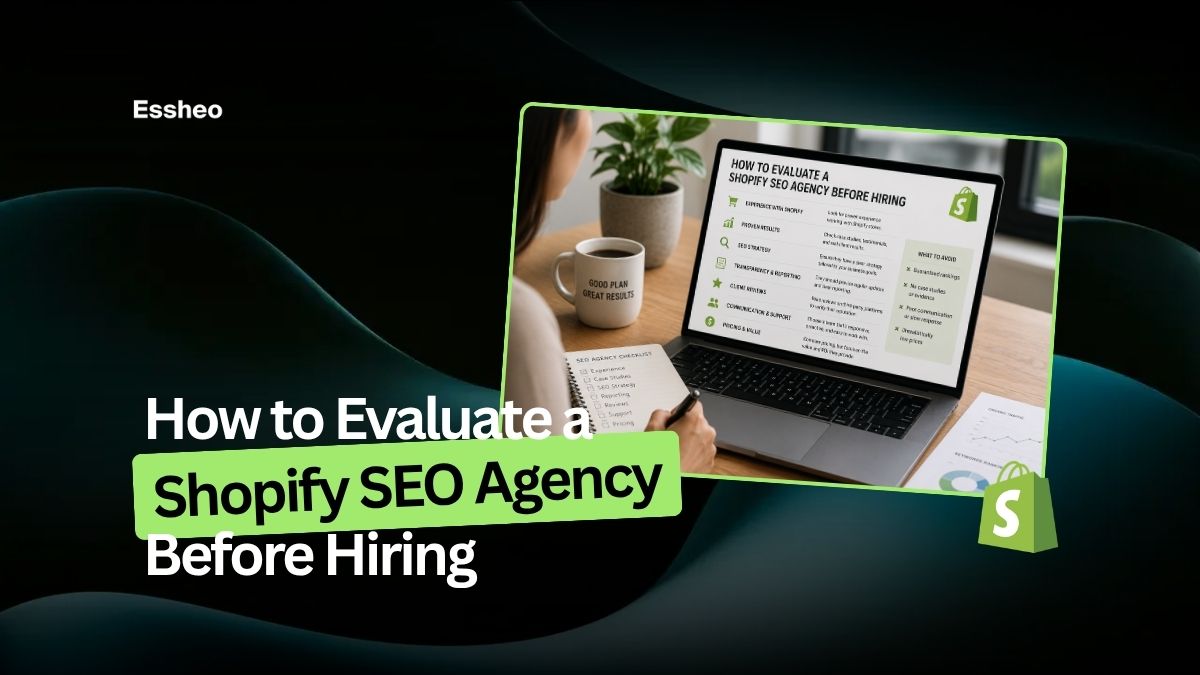
I’ve sat on the other side of the table for enough pitch calls now to know exactly which questions separate an agency that genuinely understands Shopify from one reciting a generic SEO script they’d give any client on any platform.
Most marketing managers don’t ask these questions, not because they don’t know SEO matters, but because they don’t know what a good answer is actually supposed to sound like.
I’m Myles, founder at Essheo. I’ve been on both sides of this decision, managing PPC and SEO budgets for a business that scaled past £65 million in turnover, and now running the agency answering exactly these questions from prospective clients every week.
This post is the honest version I’d want if I were the one hiring, including the questions that should make you walk away if the answer feels vague.
What Should You Ask About Their Shopify-Specific Experience?
Generic SEO experience and genuine Shopify experience are not the same thing, and this distinction matters more than most marketing managers realise going into a first call.
How Do You Handle Shopify’s Duplicate Content Structure?
Ask directly how they handle duplicate content created by Shopify’s collection filtering and variant URLs. A good answer references canonical tags, URL parameter handling, and collection structure specifically, whilst a red flag answer is something like “Shopify handles that automatically”, because it genuinely doesn’t, not without deliberate configuration.
This single question tends to expose whether an agency has actually worked hands on inside Shopify or is applying general SEO theory to a platform they don’t know intimately.
Can They Show Shopify Case Studies in Your Specific Niche or Catalogue Size?
Ask for case studies from stores similar to yours, not generic before and after screenshots, but genuine niche specific revenue and traffic figures with proper attribution attached. When reviewing any case study an agency presents, ask what the starting point was, which specific deliverables drove the result, whether the number is attributed to organic revenue or just traffic, and whether that client’s catalogue size and vertical genuinely resembles yours.
How Should They Define Success and Report On It?
This is where a lot of agencies quietly reveal whether they’re built for long term revenue growth or simply built to keep a client happy with numbers that look good on a slide.
What Metric Do They Treat as Most Important?
Ask how they define Shopify SEO success. A strong answer centres on revenue, organic conversions, and average order value, whilst a weak answer stops at rankings or traffic alone. Rankings and sessions are genuinely useful leading indicators, but they aren’t the outcome that matters to whoever is signing off your budget.
What Does Their Actual Reporting Look Like?
Ask specifically what tools they use and how they report, looking for a combination of tools like Ahrefs or Semrush alongside Google Search Console and GA4, paired with monthly reporting that includes organic revenue, not just a rank tracking dashboard.
Proper SEO reporting should include organic sourced revenue pulled directly from your CRM or ecommerce backend, organic assisted revenue using multi touch attribution, and organic customer acquisition cost calculated against total investment.
If a report only shows keyword positions climbing with no connection to actual sales, you’re not getting the full picture of whether the investment is working.
Who Will Actually Be Working on Your Account?
This is one of the most commonly overlooked questions, and it’s often the single biggest determinant of whether a campaign succeeds or quietly underdelivers for months.
Ask for Named Individuals, Not Just “A Dedicated Team”
Ask who will actually work on your account. A strong answer names a specific senior SEO practitioner, ideally alongside a Shopify developer, whilst a red flag answer is a vague reference to “a dedicated team” with no names attached.
It’s extremely common for agencies to put a senior person on the pitch call and then hand the actual work to a junior team member once the contract is signed, and this single question is one of the most effective ways to catch that pattern before it happens to you.
Why Seniority Genuinely Changes Outcomes
Advanced Shopify SEO, the kind that moves the needle against genuinely established competitors, is something an experienced practitioner executes, not something a junior team member learns on your account whilst billing your retainer for the mistakes made along the way.
Every member of our team at Essheo has 8+ years of experience in genuinely hard to rank sectors, which is precisely why we’re comfortable naming exactly who works on a client’s account before any contract is signed.
What Should Their First 30 Days Actually Include?
The honesty of an agency’s answer to this question tends to predict how honest the rest of the relationship will be, because it’s the point where sales promises meet operational reality.
A Proper First Month Includes Quick Wins, Not Just Discovery
Ask what their first 30 days look like. A strong answer includes an audit, a roadmap, and some early quick wins, whilst a weak answer treats the entire first month as discovery with nothing tangible delivered.
There’s a meaningful difference between an agency that spends a month purely gathering information and one that identifies immediate technical fixes, canonical corrections, or schema gaps that can start improving crawlability within weeks.
What Happens If a Change Hurts Rankings?
Ask what their process is if a change accidentally hurts rankings. A strong answer describes a named rollback process, a change log, and root cause analysis, whilst a genuinely worrying answer is simply “that hasn’t happened to us”, because it eventually happens to every agency doing real, hands-on work.
An agency that’s never made a mistake either hasn’t been doing enough work to cause one, or isn’t being honest with you.
How Should They Handle Contract Terms and Pricing?
This is where a lot of marketing managers get caught out, either by lock-in periods that outlast the patience of internal stakeholders, or by pricing structures that hide the true scope of what’s included.
What’s the Minimum Contract Length and Exit Terms?
Ask about minimum contract length and exit terms specifically. A transparent retainer or flat fee with a genuine pilot option available is a strong signal, whilst a twelve month lock in demanded before any results have been demonstrated is a clear red flag.
Long term partnerships genuinely produce the best compounding SEO results, we structure our own engagements around 12 and 18 month roadmaps for exactly this reason, but a long commitment should never come without accountability checkpoints built in along the way.
What Exactly Is Included in the Quoted Price?
Ask precisely what’s included in the quoted retainer and what costs extra, content production, link building, technical development time, and reporting frequency should all be clearly scoped upfront rather than discovered as surprise add ons three months in.
Are They Prepared for Where Search Is Actually Heading?
This is the question that increasingly separates agencies still selling a 2023 SEO playbook from ones genuinely equipped for how discovery works today.
How Do They Stay Current With Shopify and AI Search?
Ask how they stay current with both Shopify specifically and AI search developments. A strong answer references Shopify’s regular platform updates and a genuine AI Overview and generative engine optimisation strategy, whilst a vague answer about simply “keeping up with Google” suggests an agency that hasn’t adapted its approach to reflect how search has fragmented across platforms.
Is AI Citation Readiness Part of Their Standard Process?
Ask directly whether they structure product and category pages with the schema markup, clear answer formatting, and clean site structure that AI search tools need in order to cite a brand, or whether Google remains the only engine they’re actually optimising for.
This is precisely why we built Essheo around what we call Search Everywhere Optimisation from the outset, covering Google, AI platforms, YouTube, and the forums that large language models pull citations from, rather than treating AI visibility as an afterthought bolted onto a traditional SEO retainer once a client specifically asks for it.
Ready to Put These Questions to Us Directly?
We’d genuinely welcome every question in this post being put to us directly, because we’re confident in the specific, named answers we can give rather than the vague reassurances a lot of agencies fall back on.
Our clients have generated over £45 million in combined revenue over the last two years, and every senior practitioner on our team brings 8+ years of experience each, ranking against genuinely tough competition including household names like MoneySuperMarket, GoCompare, and uSwitch.
If you’re a marketing manager preparing to evaluate Shopify SEO agencies, I’d encourage you to bring this exact list of questions to every call you take, including ours.
Book your Shopify SEO strategy call with Essheo today, and see for yourself how a genuinely experienced team answers these questions.